Tile Adhesive Production Cost Model: Where Grip Meets Growth
_11zon.webp)
What is Tile Adhesive?
Tile adhesive manufacturing is the industrial process of producing a specialized adhesive for fixing tiles to a substrate of concrete, cement screed, plaster, drywall, or existing tiles. Tile adhesives are normally made from a combination of cement, polymers, fillers, and performance additives that improve bonding power, flexibility, water resistance, and setting times. Unlike the conventional sand-cement mortar, tile adhesives are manufactured as engineered products that offer consistent performance, ease of application, and durability. The manufacturing process involves careful formulation, mixing, and quality control to ensure consistent bonding performance for different types of tiles and application conditions.
Key Applications Across Industries:
Tile adhesives are used in the construction of residential, commercial, and industrial buildings for fixing ceramic tiles, vitrified tiles, porcelain tiles, natural stone, mosaic tiles, and large format slabs. In residential construction, tile adhesives are used in flooring and walling applications in kitchens, bathrooms, living rooms, balconies, and terraces. The tile adhesive's superior bonding performance ensures long-lasting tile fixing, even in wet or temperature-varying conditions. Tile adhesives play a critical role in commercial construction in high-traffic areas like shopping malls, hospitals, hotels, offices, airports, and educational institutions. Tile adhesives are also used in exterior cladding and façades, where the ability to resist weathering, thermal movement, and water penetration is essential. Industrial applications of tile adhesives include factories, food processing plants, laboratories, and warehouses, where tiles need to be bonded strongly to withstand chemical, vibration, and mechanical forces. Tile adhesives are also used in renovation work, where tiles can be bonded to existing surfaces without the need for demolition. Tile adhesives with different properties are used for various purposes, including fast-setting adhesives for rapid installation, flexible adhesives for surfaces that tend to move, and waterproof adhesives for areas that are wet. The versatility of tile adhesives makes them an essential part of modern construction techniques.What the Expert Says: Market Overview & Growth Drivers
The global tile adhesive market reached a value of USD 3.10 Billion in 2025. According to IMARC Group, the market is projected to reach USD 5.89 Billion by 2034, at a projected CAGR of 6.9% during 2026-2034.
The main driving factor for the global tile adhesive market is the growth in the construction and infrastructure development sectors. Urbanization and an increase in the population have led to an increase in the demand for new residential units, especially in developing countries. The modern construction trend of faster, cleaner, and more efficient installation methods has led to the replacement of traditional cement mortar with tile adhesives, thus supporting the growth in demand. The trend of using high-quality and large-format tiles is also a major driver for the tile adhesive market. Porcelain, vitrified, and large-format slab tiles require higher strength and flexibility than traditional tile adhesive methods can offer. This directly supports the growth in demand for high-quality tile adhesives that are specifically designed for use with different tile materials and substrates. The renovation and remodeling sector also supports the tile adhesive market. The aging infrastructure of developed countries and the increase in consumer spending on home renovation support the demand for tile adhesives that can make the renovation process easier and faster. Tile adhesives that support tile-on-tile installation are especially preferred for renovation purposes. Infrastructure and commercial building projects also contribute to the development of the market. Large infrastructure projects like airports, metro stations, hospitals, and commercial buildings require robust flooring and wall solutions, thus promoting the use of advanced adhesive systems. Moreover, the need for standardized and quality adhesives also promotes the development of the market, as site-mixed adhesives are less preferred due to quality concerns. On the supply side, technological advancements in polymer and additive technology have enhanced adhesive properties, thus making them suitable for various applications. Moreover, growing awareness among contractors and installers about the benefits of enhanced adhesive properties has also contributed to the development of the tile adhesive market.
Case Study on Cost Model of Tile Adhesive Production Plant:
Objective
One of our clients reached out to us to conduct a feasibility study for setting up a medium scale tile adhesive production plant.
IMARC Approach: Comprehensive Financial Feasibility
We developed a comprehensive financial model for the setup and operation of a proposed tile adhesive production plant in India. This plant is designed to manufacture 20,000 MT of tile adhesive annually.Production Process: The tile adhesive manufacturing process is a dry mix formulation process. It involves the selection and preparation of raw materials, which include cement as the binder, silica sand or fillers as the bulk material, and polymer modifiers and performance additives that improve adhesion, flexibility, water retention, and setting prop𝄹erties. All raw materials undergo testing for particle size, moisture content, and ꦛcompatibility before being used.
The main step in tile adhesive manufacturing is batching and proportioning, where each raw material is weighed according to a predetermined formula. This step is important because even a slight variation in the formula can influence the open time, bond strength, and setting properties. The raw materials are then moved to a high-efficiency dry mixer, such as a ribbon blender or ploughshare mixer, which provides even distribution of cement, fillers, polymers, and performance additives. After mixing, the tile adhesive is then subjected to quality control tests, which include flowability, bulk density, and homogeneity of dry mix. Sample batches are sometimes tested for properties such as workability, adhesion, setting time, and slip resistance by adding water to the mixture. The tile adhesive is then packed in automatic packaging machines, where it is filled into moisture-resistant bags, typically of standardized weights. It is important to ensure that the adhesive is properly sealed to prevent moisture from entering, which may cause the cement to set prematurely. The packaged tile adhesive is then palletized and stored in controlled warehouse conditions. Modern tile adhesive manufacturing plants focus on automation, dust removal, and standardized formulations, which enable tile adhesive manufacturers to manufacture a broad range of standard and specialty tile adhesives.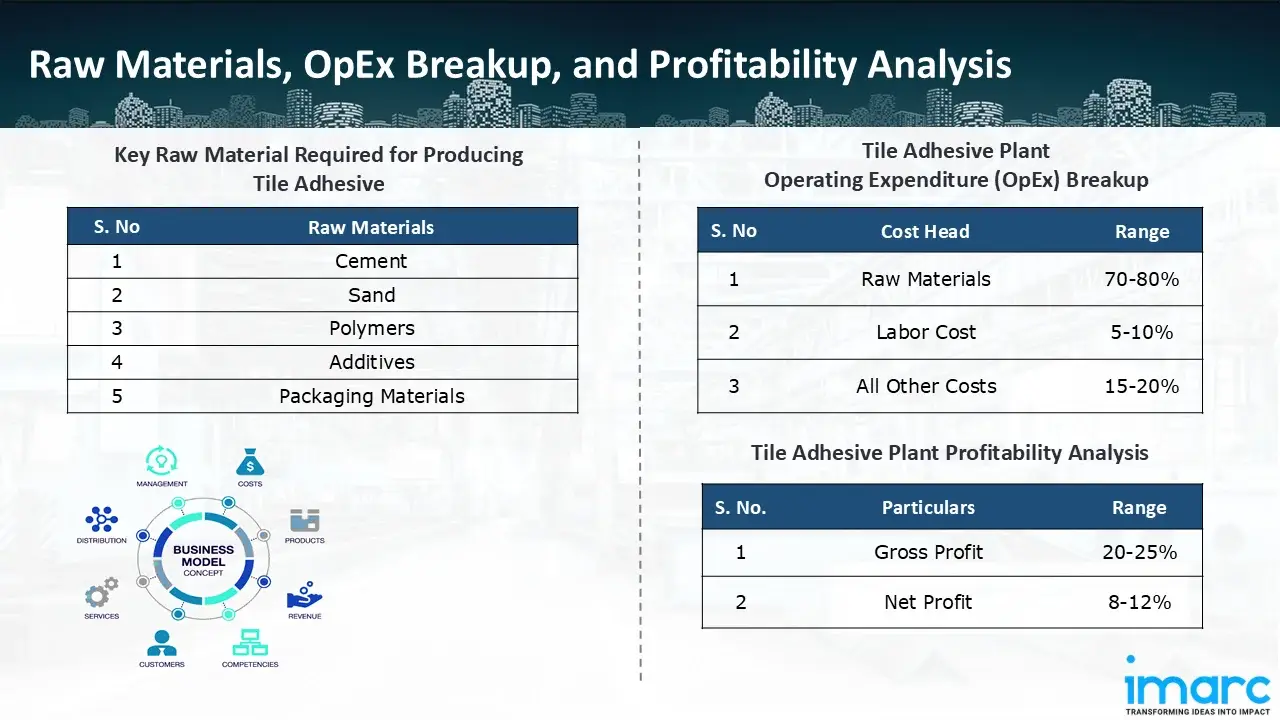
Get a Tailored Feasibility Report for Your Project Request Sample
Raw Material Required:
The basic raw materials required for tile adhesive production include:- Cement
- Sand
- Polymers
- Additives
- Packaging Materials
Machine Section or Lines Required:
- Weighing
- Mixing
- Packing
Techno-Commercial Parameter:
- Capital Expenditure (CapEx): Capital expenditure (CapEx) in a production plant includes various investments essential for its setup and long-term operations. It covers machinery and equipment costs, including procurement, installation, and commissioning. Civil works expenses involve land development, factory construction, and infrastructure setup. Utilities such as power, water supply, and HVAC systems are also significant. Additionally, material handling systems, automation, environmental compliance, and safety measures are key components. Other expenditures include IT infrastructure, security systems, and office essentials, ensuring operational efficiency and business growth.
- Operating Expenditure (OpEx): Operating expenditure is the cost incurred to operate a production plant effectively. OpEx in a production plant typically includes the cost of raw materials, utilities, depreciation, taxes, packing cost, transportation cost, and repairs and maintenance. The operating expenses are part of the cost structure of a production plant and have a significant effect on profitability and efficiency. Effective control of these costs is necessary for maintaining competitiveness and growth. Furthermore, raw material cost in tile adhesive production plant ranges between 70-80%, labor cost ranges between 5% to 10%, and all other costs ranges between 15-20% in the proposed plant.
- Profitability Analysis Year on Year Basis: We assisted our client in developing a detailed cost model, which projects steady growth, with revenue rising throughout the projected period. Moreover, gross profit margins lie between a range of 20-25%, and net profit lie between the range of 8-12% during the income projection years, highlighting strong financial viability and profitability.
Conclusion & IMARC's Impact:
Our financial model for the tile adhesive production plant was meticulously developed to meet the client’s objectives, providing an in-depth analysis of production costs, including raw materials, production, capital expenditure, and operational expenses. By addressing the specific requirements of production 20,000 MT of tile adhesive annually, we successfully identified key cost drivers and projected profitability, considering market trends, inflation, and potential fluctuations in raw material prices. This comprehensive financial model equipped the client with valuable insights into strategic decision-making, demonstrating our commitment to delivering high-quality, client-focused solutions that ensure the long-term success of large-scale production ventures.Latest News and Developments:
- In July 2025, one of the top building and construction companies in India, Birla White, has introduced its newest invention, TileStix, a white cement-based tile adhesive, through a distinctive and captivating new 'Talking Tiles' campaign.
- In February 2025, the acquisition of FOSROC, a major player in the global building chemicals market with a significant geographic presence in India, the Middle East, and Asia-Pacific in particular, was finalised by Saint-Gobain.
- In January 2025, Sika has established two cutting-edge facilities in Xi'an, Northwest China, and Singapore. While the Xi'an facility produces a wide range of Sika products, such as tile adhesives, cementitious waterproofing, and flooring solutions, the recently constructed factory in Singapore specialises in mortar production. Sika will be able to respond more effectively to local market demands and drastically cut down on logistical distances with both operations.
Why Choose IMARC?
IMARC's Financial Model Expertise: Helping Our Clients Explore Industry Economics
IMARC is a global market research company that offers a wide range of services, including market entry and expansion, market entry and opportunity assessment, competitive intelligence and benchmarking, procurement research, pricing and cost research, regulatory approvals and licensing, factory setup, factory auditing, company incorporation, incubation services, recruitment services, and marketing and sales. Under our factory setup services, we assist our clients in exploring the feasibility of their plants by providing comprehensive financial modeling. Additionally, we offer end-to-end consultation for setting up a plant in India or abroad. Our financial modeling includes an analysis of capital expenditure (CapEx) required to establish the production facility, covering costs such as land acquisition, building infrastructure, purchasing high-tech production equipment, and installation. Furthermore, the layout and design of the factory significantly influence operational efficiency, energy consumption, and labor productivity, all of which impact long-term operational expenditure (OpEx). So, every parameter is covered in the analysis. At IMARC, we leverage our comprehensive market research expertise to support companies in every aspect of their business journey, from market entry and expansion to operational efficiency and innovation. By integrating our factory setup services with our deep knowledge of industry dynamics, we empower our clients to not only establish production facilities but also strategically position themselves in highly competitive markets. Our financial modeling and end-to-end consultation services ensure that clients can explore the feasibility of their plant setups while also gaining insights into competitors' strategies, technological advancements, and regulatory landscapes. This holistic approach enables our clients to make informed decisions, optimize their operations, and align with sustainable practices, ultimately driving long-term success and growth.Our Clients







Contact Us
Have a question or need assistance?
Please complete the form witꦫh your inquiry or reach out to us at
🅺
+1-201-971-6302
+44-753-714-6104
Previous Post
