Optimized Cost Framework for Nitrile Gloves Manufacturing: A Data-Driven Approach

What is Nitrile Gloves?
Nitrile gloves are synthetic rubber gloves that are extensively used in the medical, industrial, and food industries because of their strength, resistance to chemicals, and hypoallergenic nature.
Key Applications Across Industries:
They are ideal for people with allergies since they are latex-free, as opposed to latex gloves. They are more flexible, puncture-resistant, and resistant to infection and chemicals. The demand for nitrile gloves in manufacturing, healthcare, and laboratory environments is increasing because of stringent safety regulations and increasing hygiene consciousness, which is driving the worldwide market growth.What the Expert Says: Market Overview & Growth Drivers
According to an IMARC study, the global nitrile gloves market reached USD 9.1 Billion in 2025. Looking ahead, the market is expected to grow at a CAGR of 5.17% from 2026 to 2034, reaching a projected size of USD 14.5 Billion by 2034. Several significant factors drive nitrile gloves demand. The increasing consciousness regardin🉐g hygiene and infection control among medical, food processing, and manufacturing industries stimulates growth.
High standards of safety laws in pharmaceuticals, medicals, and chemical industries further boost market expansion. The greater puncture resistance, strength, and chemical protection provided by nitrile gloves have made them the first choice compared to latex gloves, particularly among individuals who have latex allergies. The growing health care industry, powered by demographic aging and the growth in medical procedures, perpetuates ongoing demand. Furthermore, expanding focus on safety in work settings in the manufacturing, auto, and lab environments also encourages market growth. The COVID-19 pandemic tremendously accelerated worldwide demand, further sustaining long-term realization of personal protection equipment (PPE). Developing technologies in the manufacture of gloves, resulting in greater comfort and environmentally friendly disposal, also boost market growth. Increased industrial automation and food safety requirements further enhance the need for nitrile gloves in different industries.Case Study on Cost Model of Nitrile Gloves Manufacturing Plant:
Objective
One of our clients has approached us to conduct a feasibility study for establishing a mid to large-scale nitrile gloves manufacturing plant in Dammam, Saudi Arabia.IMARC Approach: Comprehensive Financial Feasibility
We have developed a detailed financial model for the plant's setup and operations. The proposed facility is designed with a production capacity of 3.6 tons of nitrile gloves per day.Manufacturing Process: The production of nitrile gloves starts with the allocation of raw materials, mostly Nitrile Butadiene Rubber (NBR), a copolymer of acrylonitrile and butadiene, for chemical resistance and flexibility. The vulcanization step ᩚᩚᩚᩚᩚᩚᩚᩚᩚ𒀱ᩚᩚᩚcomes next, where zinc oxide, accelerators, and antioxidants are blended, stirred, and allowed to settle before being shipped to production tanks. The ceramic hand molds are subsequently washed with acid, alkaline solutions, and hot water to eliminate residues. After being cleaned, the molds are subjected to the dipping process, initially into a coagulant solution (calcium nitrate and calcium carbonate) and then into an NBR latex blend, controlling the glove thickness. The leaching process eliminates residual chemicals via hot water treatment, then post-vulcanization in ovens for elasticity. Demolding and auto-stripping with air pressure and mechanical stripping follow. Lastly, the gloves undergo quality testing, such as pinhole leak tests, and are packaged and warehoused prior to shipping.
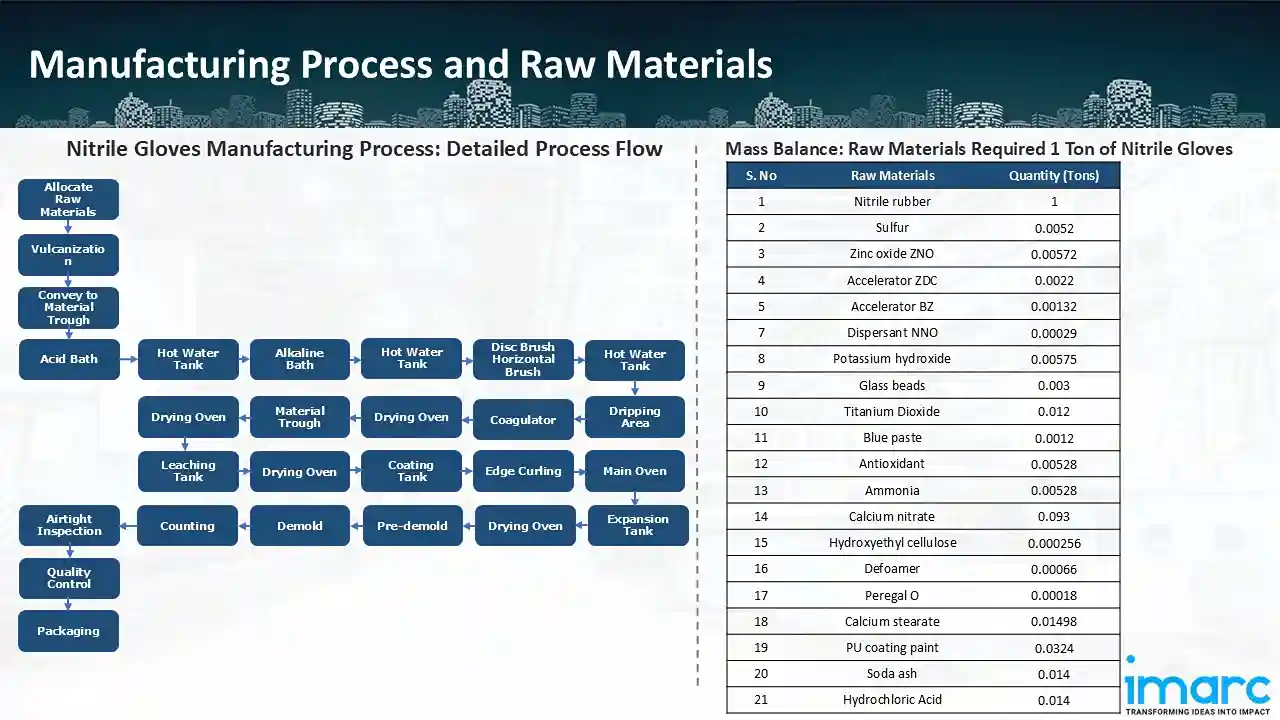
Mass Balance and Raw Material Required: The primary raw materials utilized in the nitrile gloves manufacturing plant largely include nitrile rubber, sulfur, zinc oxide ZNO, accelerator ZDC accelerator BZ, dispersant NNO, potassium hydroxide, glass beads, titanium dioxide, blue paste, antioxidant, ammonia, calcium nitrate, hydroxyethyl cellulose, defoamer, Peregal O, calcium stearate, PU coating paint, soda ash, and Hydrochlor𒆙ic acid. To produce 1 ton of nitrile gloves, we require 1 ton of nitrile rubber, 0.0052 tons of sulfur, 0.00572 tons of zinc oxide, 0.0022 tons of accelerator ZDC, 0.00132 tons of accelerator BZ, 0.00029 tons of dispersan♏t NNO, 0.00575 tons of potassium hydroxide, 0.003 tons of glass beads, 0.012 tons of titanium dioxide, 0.0012 tons of blue paste, 0.00528 tons of antioxidants, 0.00528 tons of ammonia, 0.093 tons of calcium nitrate, 0.000256 tons of hydroxyethyl cellulose, 0.00066 tons of defoamer, 0.00018 tons of peregal O, 0.01498 tons of calcium stearate, 0.0324 PU coating paint, 0.014 tons of soda ash, and 0.014 tons of hydrochloric acid.
List of Machinery:
The following equipment was required for the proposed plant:- Latex Glove Dipping Machine, double hand former
- Auto stripper
- Automatic counting machine
- Porcelain Examination Glove Former
- Glove mold holder
- Acid tank
- Alkali tank
- Hot water/Starch tank
- Leaching tank
- Latex tank
- Coagulant tank
- Washing molds tank
- Machine frame materials
- Chain
- Sprocket
- Radiating pipes
- Horizontal brush
- Insulation board
- Vulcanization Tank
- Polymer Tank
- Coagulant mixing tank
- Storage tank
- Sand mill
- Stairs, treads, aisles, guardrails
- Air Duct
- PLC
- Motor
- Diaphragm Pump, Transport pipe
- Filter
- Water Purified
- Chiller
- Hot blast stove-burner
- Steam generator
- Air Compressor
- Air Storage Tank
- Tensile Tester
- Viscometer
- Electronic Balance
- Thickness Meter
- Alcohol thermometer
- Hydrometer
Techno-Commercial Parameter:
- Capital Investment (CapEx): Capital expenditure (CapEx) in a manufacturing plant includes various investments essential for its setup and long-term operations. It covers machinery and equipment costs, including procurement, installation, and commissioning. Civil works expenses involve land development, factory construction, and infrastructure setup. Utilities such as power, water supply, and HVAC systems are also significant. Additionally, material handling systems, automation, environmental compliance, and safety measures are key components. Other expenditures include IT infrastructure, security systems, and office essentials, ensuring operational efficiency and business growth.
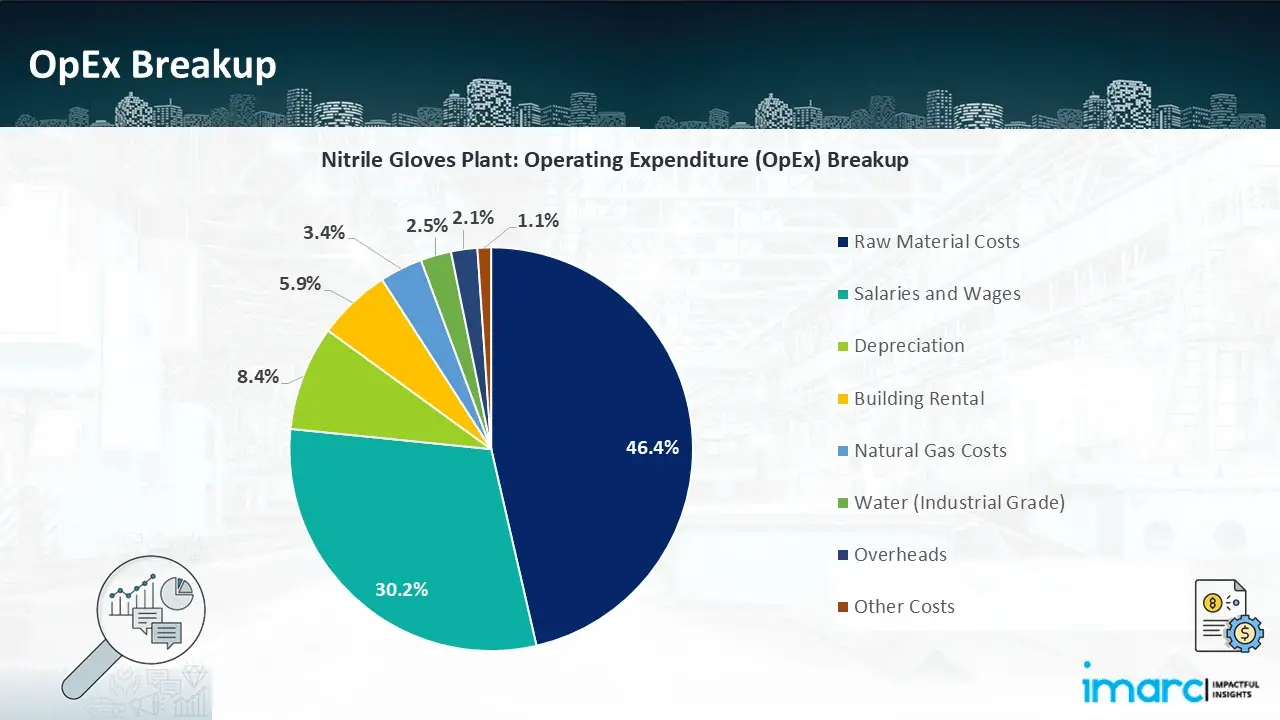
- Operating Expenditure (OpEx): Operating expenditure is the cost incurred to operate a manufacturing plant effectively. OpEx in a manufacturing plant typically includes the cost of raw materials, utilities, depreciation, taxes, packing cost, transportation cost, and repairs and maintenance. The operating expenses are part of the cost structure of a manufacturing plant and have a significant effect on profitability and efficiency. Effective control of these costs is necessary for maintaining competitiveness and growth.
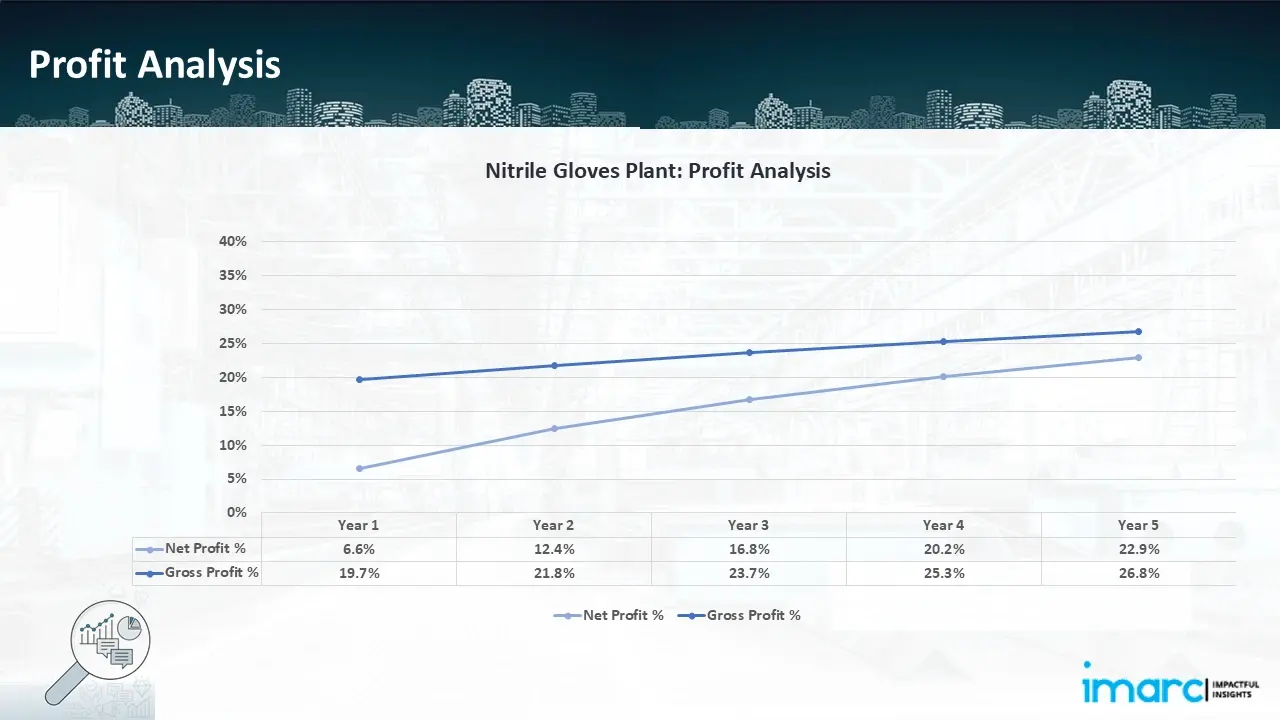
- Profitability Analysis Year on Year Basis: The proposed nitrile gloves plant, with a capacity of 3.6 tons of nitrile gloves per day, achieved an impressive revenue of US$ 4.5 million in its first year. We assisted our client in developing a detailed cost model, which projects steady growth, with revenue rising throughout the projected period. Moreover, gross profit improved from 19.7% to 26.8%, and net profit rise from 6.6% to 22.9%, highlighting strong financial viability and operational efficiency.
Conclusion & IMARC's Impact:
Our nitrile gloves manufacturing plant's financial model was meticulously modelled to satisfy the client's requirements. It provided a thorough analysis of production costs including capital expenditures, manufacturing processes, raw materials, and operating costs. The model predicts profitability while accounting for market trends, inflation, and any shifts in the price of raw materials. It was created especially to satisfy the demand of producing 3.6 tons of nitrile gloves per day. Our commitment to offering precise, client-cantered solutions that ensure the long-term success of significant industrial projects by giving the client useful data for strategic decision-making is demonstrated by this comprehensive financial model.Latest News and Developments:
- In February 2025, Wadi Surgicals, a nitrile glove manufacturing start-up out of Hyderabad, which has commenced production of gloves for surgical use in May 2023, is looking to increase capacity at its Visakhapatnam plant before entering export markets and an increase in demand it expects within the domestic market once quality compliance standards and tougher import regulations are established.
- In October 2024, Unigloves, a global hand protection leader, and KluraLabs, antimicrobial solution innovators, have combined to introduce the CrossGuard antimicrobial nitrile glove, the first antimicrobial glove capable of destroying 99.99% of specific bacteria in as little as 60 seconds. This innovation has been third-party tested and does not contain any active ingredients.
- In January 2024, Local glove manufacturers have called on the government to take strong action to increase levels of quality to limit dumping and importation of low-quality bulk-packed gloves for medical use in India. The nitrile glove manufacturers are meeting with the Bureau of Indian Standards (BIS) on Wednesday requesting that they act as the market is being filled with low quality glove dumping.
- In April 2022, Canada-headquartered AMD Medicom Inc. ("Medicom"), a global top-ranked manufacturer and distributor of personal protective equipment (PPE), announces the establishment of Manikheir Canada Inc. ("Manikheir Canada"), a new subsidiary that will manufacture nitrile gloves in London, Ontario. This new expansion has been facilitated through collaboration with the Ontario government, which has agreed to purchase 500 million locally made nitrile medical examination gloves annually for its healthcare system.
Why Choose IMARC:
IMARC's Financial Model Expertise: Helping Our Clients Explore Industry Economics
IMARC is a global market research company that offers a wide range of services, including market entry and expansion, market entry and opportunity assessment, competitive intelligence and benchmarking, procurement research, pricing and cost research, regulatory approvals and licensing, factory setup, factory auditing, company incorporation, incubation services, recruitment services, and marketing and sales.Brief List of Our Services: Market Entry and Expansion
- Market Entry and Opportunity Assessment
- Competitive Intelligence and Benchmarking
- Procurement Research
- Pricing and Cost Research
- Sourcing
- Distribution Partner Identification
- Contract Manufacturer Identification
- Factory Setup
- Factory Auditing
- Company Incorporation
- Incubation Services
- Recruitment Services
- Marketing and Sales
Under our factory setup services, we assist our clients in exploring the feasibility of their plants by providing comprehensive financial modeling. Additionally, we offer end-to-end consultation for setting up a plant in India or abroad. Our financial modeling includes an analysis of capital expenditure (CapEx) required to establish the manufacturing facility, covering coᩚᩚᩚᩚᩚᩚᩚᩚᩚ𒀱ᩚᩚᩚsts such as land acquisition, building infrastructure, purchasing high-tech production equipment, and installation. Furthermore, the layout and design of the factory significantly influence operational efficiency, energy consumption, and labor productivity, all of which impact long-term operational expenditure (OpEx). So, every parameter is covered in the analysis.
At IMARC, we leverage our comprehensive market research expertise to support companies in every aspect of their business journey, from market entry and expansion to operational efficiency and innovation. By integrating our factory setup services with our deep knowledge of industry dynamics, we empower our clients to not only establish manufacturing facilities but also strategically position themselves in highly competitive markets. Our financial modeling and end-to-end consultation services ensure that clients can explore the feasibility of their plant setups while also gaining insights into competitors' strategies, technological advancements, and regulatory landscapes. This holistic approach enables our clients to make informed decisions, optimize their operations, and align with sustainable practices, ultimately driving long-term success and growth.Our Clients







Contact Us
Have a question or need assistance?
💙 Please complete the form with🍌 your inquiry or reach out to us at
+1-201-971-6302
+44-753-714-6104
Previous Post
