Plastic Crates Manufacturing Cost Analysis: Built to Stack, Built to Last

What are Plastic Crates?
Plastic crates are a rigid and reusable construction with a production material that includes a thermoplastic such as high-density polyethylene (HDPE) and Polypropylene (PP). These crates have design features that ensure the efficient storage, transport, and handling of goods while having a strong load-bearing capacity and a longer life span. The plastic crates can be manufactured in standard and custom sizes and can be either solid, ventilated, collapsible, and stackable, based on their end uses and functions. In comparison with boxes made of wood and corrugated fibers, plastic crates have certain advantages with regard to hygiene, moisture, and uniformity, and can be reused for various purposes.Key Applications Across Industries:
Plastic crates find many applications throughout the agricultural, food & beverage, retail, logistics, and industrial sectors due to their strength & reusability. Starting from the agricultural industry, plastic crates are largely used for the harvesting, storage, and transportation of fruits, vegetables, and dairy products. Ventilated packaging designs help retain airflow, thus preventing spoilage and keeping the products cool during transport. Moving on to the food and beverages sector, plastic packaging product designs are largely used for products such as bottled drinks, packaged foods, bakery products, and meat products due to their hygiene and ease of cleanability. Plastic crates are used for storage, order picking, and material transfer at retail and distribution centers for behind-the-scenes functions. The plastic crate is stackable and nestable to optimize space utilization. For cold chain logistics shipments of seafood, frozen foods, and pharmaceuticals, plastic crates are reliable at low temperatures. Industrial usage ranges from handling car parts, electronics, chemicals, and other manufactured goods. Plastic crates serve to safeguard the product against any form of damage and also enable standardization in handling and logistical systems. They also find usage in postal services, e-commerce holding facilities, and in the transport system of “returnable transport packaging” or RTPs because they need to be “re-circulated.”Also, plastic containers have other applications in the hotel, brewing, dairy products, and in𓆉stitutional catering sectors. In fact, their durability, ability to handle automated handling equipment, as well as durability when subjected to rough handling, makes them a desirable option for high-volume, repetitive logistics applications.
What the Expert Says: Market Overview & Growth Drivers
The global plastic crates market reached a value of USD 6.17 Billion in 2025. According to IMARC Group, the market is projected to reach USD 8.78 Billion by 2034, at a projected CAGR of 4.0% during 2026-2034. Factors driving the global plastic crate market include the rising need for efficient, reusable, and cost-effective logistics solutions across different sectors. Among the major driving forces behind the plastic crate market include the increasing organized supply chains ꦅacross the agriculture, food processing, and retail sectors. As supply chains become more organized and quality-oriented, there has been a rising trend among businesses towards adoption of uniform containers that enhance handling ease and minimize product damages during handling. Plastic crates me🍰et such requirements.
Factors of sustainability and waste reduction are significantly impactful in the growth of the market. Plastic crates promote multiple cycles of use compared to disposable packaging materials. Consequently, there is less packaging waste. Most organizations have resorted to returnable transport packaging in order to align with the concept of the circular economy. Plastic crates are compatible with the above concepts. E-commerce and modern retail logistics growth is another significant driver. High-volume distribution and last-mile delivery operations entail the use of robust containers that can easily be integrated with automated systems. This is because plastic crates can be easily integrated with automated systems like warehouse management systems, robots, and conveyor systems. Food and beverages continue to be a source of large demands because of the emphasis on cleanliness, traceability, and compliance. It is easy to clean, resists moisture, and protects against pests. Cold chain growth is also an impetus because plastic functions well under extreme temperatures. Advances in technology applied to polymer materials and the design of the actual crates—like the development of foldable and light-weight material structures—have added more functionality and economic viability. These trends, combined with the industrialization of the world trade and the focus on supply chain rationalization, contribute towards the overall global demands for plastic crate production.
Case Study on Cost Model of Plastic Crates Manufacturing Plant:
Objective
One of our clients reached out to us to conduct a feasibility study for setting up a medium scale plastic crates manufacturing plant.
IMARC Approach: Comprehensive Financial Feasibility
We developed a comprehensive financial model for the setup and operation of a proposed plastic crates manufacturing plant in India. This plant is designed to manufacture 1,000 tons of plastic crates annually.Manufacturing Process: The process of manufacturing plastic crates comprises various polymer processing and molding techniques to yield robust and reusable containers. The initial step in plastic crate manuܫfacturing is the selection of thermoplastic materials like high-density polyethylene (HDPE) and polypropylene (PP), which are chosen on account of their high resistance to impacts and their weight-bearing capacity. The granules of virgin or reclaimed polymers undergo evaluation and processing in accordance with their demand in order to ensure their melt flow properties. Other additives, including color masterbatches and UV stabilizers or anti-static agents, may be added during this processing. The processed material is then fed into the injection molding machine, where heating and melting processes are done. The melted polymer is then injected into steel molds that have been precision-engineered into shapes required for crate production, with features such as crate walls, bottom, handles, and ventilation holes. Strong clamping forces help in mold replication in terms of size and ribs that provide additional strength. Finally, cooling is done to solidify the plastic and discharge the crate. There can be post-molding operations such as trimming off excess material, edge finishing, and checking quality. The crates are inspected for dimensional accuracy, thickness of the walls, weight, and integrity of construction. Then there can be loading tests or impact tests in order to check a certain level of performance. The finished crate can then be labeled, printed, or tagged with RFID tags for a trace in the logistics system. The finished crates are then palletized, packed, and stored away for shipping. There can be stress on automation, recycling of material, and energy efficiency in the entire process.
Get a Tailored Feasibility Report for Your Project Request Sample
Raw Material Required:
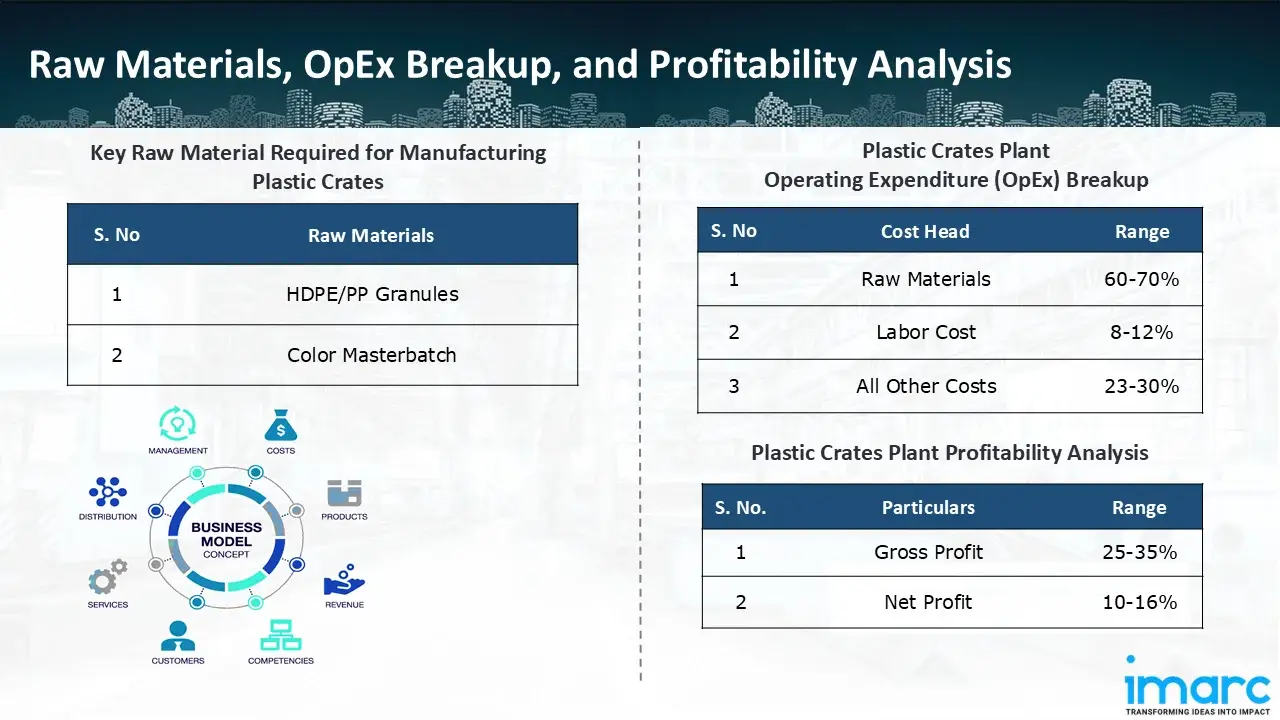
The basic raw materials required for plastic crates manufacturing include:- HDPE/PP Granules
- Color Masterbatch
Machine Section or Lines Required:
- Injection Molding Machine
- Mold
Techno-Commercial Parameter:
- Capital Expenditure (CapEx): Capital expenditure (CapEx) in a manufacturing plant includes various investments essential for its setup and long-term operations. It covers machinery and equipment costs, including procurement, installation, and commissioning. Civil works expenses involve land development, factory construction, and infrastructure setup. Utilities such as power, water supply, and HVAC systems are also significant. Additionally, material handling systems, automation, environmental compliance, and safety measures are key components. Other expenditures include IT infrastructure, security systems, and office essentials, ensuring operational efficiency and business growth.
- Operating Expenditure (OpEx): Operating expenditure is the cost incurred to operate a manufacturing plant effectively. OpEx in a manufacturing plant typically includes the cost of raw materials, utilities, depreciation, taxes, packing cost, transportation cost, and repairs and maintenance. The operating expenses are part of the cost structure of a manufacturing plant and have a significant effect on profitability and efficiency. Effective control of these costs is necessary for maintaining competitiveness and growth. Furthermore, raw material cost in plastic crates manufacturing plant ranges between 60-70%, labor cost ranges between 8% to 12%, and all other costs ranges between 23-30% in the proposed plant.
- Profitability Analysis Year on Year Basis: We assisted our client in developing a detailed cost model, which projects steady growth, with revenue rising throughout the projected period. Moreover, gross profit margins lie between a range of 25-35%, and net profit lie between the range of 10-16% during the income projection years, highlighting strong financial viability and profitability.
Conclusion & IMARC's Impact:
Our financial model for the plastic crates manufacturing plant was meticulously developed to meet the client’s objectives, providing an in-depth analysis of production costs, including raw materials, manufacturing, capital expenditure, and operational expenses. By addressing the specific requirements of manufacturing 1000 tons of plastic crates annually, we successfully identified key cost drivers and projected profitability, considering market trends, inflation, and potential fluctuations in raw material prices. This comprehensive financial model equipped the client with valuable insights into strategic decision-making, demonstrating our commitment to delivering high-quality, client-focused solutions that ensure the long-term success of large-scale manufacturing ventures.Latest News and Developments:
- In April 2025, IPL, a well-known Dublin-based plastics maker and packing supplier, announced its plans to merge with Schoeller Allibert, a Dutch company.
- In March 2025, Tetra Pak and Schoeller Allibert announced its plans to introduce a new transport crate made of polyAl from old beverage cartons at the Plastics Recycling Show in Amsterdam, as a creative move towards a circular economy and as a consequence of tight collaboration.
Why Choose IMARC?
IMARC's Financial Model Expertise: Helping Our Clients Explore Industry Economics
IMARC is a global market research company that offers a wide range of services, including market entry and expansion, market entry and opportunity assessment, competitive intelligence and benchmarking, procurement research, pricing and cost research, regulatory approvals and licensing, factory setup, factory auditing, company incorporation, incubation services, recruitment services, and marketing and sales. Under our factory setup services, we assist our clients in exploring the feasibility of their plants by providing comprehensive financial modeling. Additionally, we offer end-to-end consultation for setting up a plant in India or abroad. Our financial modeling includes an analysis of capital expenditure (CapEx) required to establish the manufacturing facility, covering costs such as land acquisition, building infrastructure, purchasing high-tech production equipment, and installation. Furthermore, the layout and design of the factory significantly influence operational efficiency, energy consumption, and labor productivity, all of which impact long-term operational expenditure (OpEx). So, every parameter is covered in the analysis. At IMARC, we leverage our comprehensive market research expertise to support companies in every aspect of their business journey, from market entry and expansion to operational efficiency and innovation. By integrating our factory setup services with our deep knowledge of industry dynamics, we empower our clients to not only establish manufacturing facilities but also strategically position themselves in highly competitive markets. Our financial modeling and end-to-end consultation services ensure that clients can explore the feasibility of their plant setups while also gaining insights into competitors' strategies, technological advancements, and regulatory landscapes. This holistic approach enables our clients to make informed decisions, optimize their operations, and align with sustainable practices, ultimately driving long-term success and growth.Our Clients







Contact Us
Have a question or need assistance?
Please complete the form with your inqu🃏iry or reach out to us at
💙
+1-201-971-6302
+44-753-714-6104
Previous Post
