Toughened Glass Manufacturing Cost Analysis: Crystal Clear, Structurally Strong
_11zon.webp)
What is Toughened Glass?
Toughened glass production is the industrial process of making safety glass that is much stronger and more resistant to impact than regular annealed glass. The production process involves heating flat glass to high temperatures and then rapidly cooling it, which causes compressive stresses on the surface and tensile stresses in the core. Toughened glass, when broken, breaks into small, rounded pieces that are less likely to cause injury compared to regular glass. The manufacturing process requires high precision and control of temperatures to ensure consistency in safety standards.
Key Applications Across Industries:
Toughened glass is widely applied in the construction, automotive, and consumer industries owing to its improved safety and durability. In the construction industry, toughened glass is applied in the manufacture of windows, doors, façades, partitions, staircases, balustrades, skylights, and shower enclosures. Its ability to resist wind pressure, temperature changes, and accidental impact makes it ideal for both residential and commercial buildings. In the automotive industry, toughened glass is mainly utilized for the side windows and rear windshields of vehicles. The breaking pattern of the glass reduces the risk of injury during an accident, making it an important aspect of vehicle safety design. Toughened glass is also used in interior design applications such as tabletops, shelves, cabinets, and furniture. In the retail and hospitality sectors, toughened glass is used in display cases, counters, and barriers. The glass is clear and durable, making it an important aspect of these industries. Toughened glass is also used in appliances and electronics such as oven doors, refrigerator shelves, and electronic display screens. In the solar industry and other industrial applications, toughened glass is used as protective glazing for panels and equipment.What the Expert Says: Market Overview & Growth Drivers
The global toughened glass market reached a value of USD 59.42 Billion in 2025. According to IMARC Group, the market is projected to reach USD 89.14 Billion by 2034, at a projected CAGR of 4.61% during 2026-2034.
The toughened glass market is fueled by the structural changes that are taking place in the construction, transportation, and consumer safety sectors. The first major factor that is driving the market is the increasing urbanization and development of infrastructure. As the cities continue to grow and develop, there is an increasing need for high-rise buildings, commercial spaces, and infrastructure that require robust and safe glazing solutions. Toughened glass is increasingly being used by architects and engineers for its strength and safety properties. The second major factor that is driving the toughened glass market is the increasing focus on safety regulations and building codes. Many countries have made it mandatory to use safety glass in critical areas such as doors, windows, facades, and public spaces. This has led to an increasing focus on replacing regular glass with toughened glass, thereby driving demand. The automotive industry production trends are also a major factor that is contributing to the toughened glass market. As the vehicle manufacturers continue to focus on occupant safety and lightweight vehicles, toughened glass continues to be a critical component for side and rear glazing. The increasing number of vehicles on the road continues to drive demand from this sector. Lifestyle and design trends also contribute to the growth of the market. The rising preference for modern interior design, open space designs, and glass-based furniture boosts the demand for strong and attractive glass. The use of toughened glass allows designers to incorporate larger glass surfaces without affecting safety. Technological advancements in glass processing, automation, and quality control have enhanced the efficiency of production and made toughened glass more affordable. Along with the growing awareness of safety, durability, and aesthetics, these factors combined contribute to the demand for toughened glass manufacturing globally across various industries.
Case Study on Cost Model of Toughened Glass Manufacturing Plant:
Objective
One of our clients reached out to us to conduct a feasibility study for setting up a medium scale toughened glass manufacturing plant.
IMARC Approach: Comprehensive Financial Feasibility
We developed a comprehensive financial model for the setup and operation of a proposed toughened glass manufacturing plant in India. This plant is designed to manufacture 1 million sq. meter toughened glass annually.Manufacturing Process: The production process of toughened glass involves a controlled thermal process applied to flat glass to improve its strength and safety properties. The process starts with cutting and edge work of annealed float glass to the desired size. All the cutting, drilling, and edge work must be carried out at this stage because tough𝓰ened glass cannot be worked after the thermal process without breaking.
After preparation, the glass is washed and inspected to eliminate dust, oils, or defects on the surface that could compromise the strength of the glass when heated. The cleaned glass is then loaded into a toughening furnace where it is heated to a temperature near its softening point, usually 600-650°C. Temperature control is critical to ensure the entire glass is at an equal temperature. The glass is then immediately subjected to rapid quenching, where high-pressure air jets quickly cool the glass surfaces. The rapid cooling process causes the outer surfaces of the glass to solidify faster than the inner core. As the inner core cools and contracts, it generates compressive stress on the surfaces and tensile stress in the core. This stress distribution is what gives toughened glass its improved mechanical properties and thermal resistance. The glass is then inspected for quality control and testing, which involves assessing its flatness, optical distortion, surface compression strength, and fragmentation characteristics. The tested glass is then packaged and shipped to construction, automotive, or industrial sites for use. Contemporary toughened glass factories focus on automation, energy conservation, and process control to ensure high safety standards and production efficiency.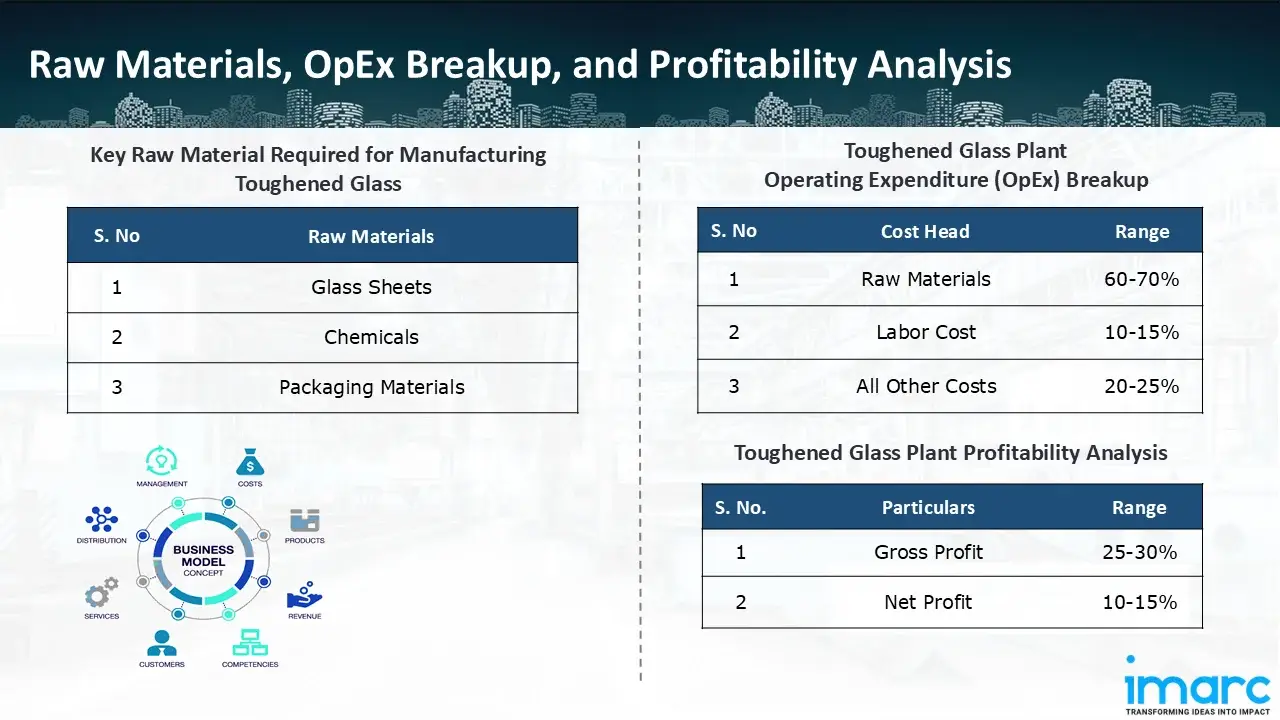
Get a Tailored Feasibility Report for Your Project Request Sample
Raw Material Required:
The basic raw materials required for toughened glass manufacturing include:- Glass Sheets
- Chemicals
- Packaging Materials
Machine Section or Lines Required:
- Cutting
- Edging
- Washing
- Heating
- Quenching
- Packing
Techno-Commercial Parameter:
- Capital Expenditure (CapEx): Capital expenditure (CapEx) in a manufacturing plant includes various investments essential for its setup and long-term operations. It covers machinery and equipment costs, including procurement, installation, and commissioning. Civil works expenses involve land development, factory construction, and infrastructure setup. Utilities such as power, water supply, and HVAC systems are also significant. Additionally, material handling systems, automation, environmental compliance, and safety measures are key components. Other expenditures include IT infrastructure, security systems, and office essentials, ensuring operational efficiency and business growth.
- Operating Expenditure (OpEx): Operating expenditure is the cost incurred to operate a manufacturing plant effectively. OpEx in a manufacturing plant typically includes the cost of raw materials, utilities, depreciation, taxes, packing cost, transportation cost, and repairs and maintenance. The operating expenses are part of the cost structure of a manufacturing plant and have a significant effect on profitability and efficiency. Effective control of these costs is necessary for maintaining competitiveness and growth. Furthermore, raw material cost in toughened glass manufacturing plant ranges between 60-70%, labor cost ranges between 10% to 15%, and all other costs ranges between 20-25% in the proposed plant.
- Profitability Analysis Year on Year Basis: We assisted our client in developing a detailed cost model, which projects steady growth, with revenue rising throughout the projected period. Moreover, gross profit margins lie between a range of 25-30%, and net profit lie between the range of 10-15% during the income projection years, highlighting strong financial viability and profitability.
Conclusion & IMARC's Impact:
Our financial model for the toughened glass manufacturing plant was meticulously developed to meet the client’s objectives, providing an in-depth analysis of production costs, including raw materials, manufacturing, capital expenditure, and operational expenses. By addressing the specific requirements of manufacturing 1 million square meters of toughened glass annually, we successfully identified key cost drivers and projected profitability, considering market trends, inflation, and potential fluctuations in raw material prices. This comprehensive financial model equipped the client with valuable insights into strategic decision-making, demonstrating our commitment to delivering high-quality, client-focused solutions that ensure the long-term success of large-scale manufacturing ventures.Latest News and Developments:
- In August 2025, India’s first tempered glass production facility was opened by Union Electronics and IT Minister Ashwini Vaishnaw. It is a joint venture between Corning, the top materials science developer in the world, and Optiemus Infracom, an Indian manufacturer of electronic equipment.
- In July 2025, Saint-Gobain released product activity showcasing a hardened version of its SGG Colormaxx Dura line, indicating ongoing product innovation targeted at architectural and interior applications.
Why Choose IMARC?
IMARC's Financial Model Expertise: Helping Our Clients Explore Industry Economics
IMARC is a global market research company that offers a wide range of services, including market entry and expansion, market entry and opportunity assessment, competitive intelligence and benchmarking, procurement research, pricing and cost research, regulatory approvals and licensing, factory setup, factory auditing, company incorporation, incubation services, recruitment services, and marketing and sales. Under our factory setup services, we assist our clients in exploring the feasibility of their plants by providing comprehensive financial modeling. Additionally, we offer end-to-end consultation for setting up a plant in India or abroad. Our financial modeling includes an analysis of capital expenditure (CapEx) required to establish the manufacturing facility, covering costs such as land acquisition, building infrastructure, purchasing high-tech production equipment, and installation. Furthermore, the layout and design of the factory significantly influence operational efficiency, energy consumption, and labor productivity, all of which impact long-term operational expenditure (OpEx). So, every parameter is covered in the analysis. At IMARC, we leverage our comprehensive market research expertise to support companies in every aspect of their business journey, from market entry and expansion to operational efficiency and innovation. By integrating our factory setup services with our deep knowledge of industry dynamics, we empower our clients to not only establish manufacturing facilities but also strategically position themselves in highly competitive markets. Our financial modeling and end-to-end consultation services ensure that clients can explore the feasibility of their plant setups while also gaining insights into competitors' strategies, technological advancements, and regulatory landscapes. This holistic approach enables our clients to make informed decisions, optimize their operations, and align with sustainable practices, ultimately driving long-term success and growth.Our Clients










Contact Us
Have a question or need assistance?
Please complete the form with your inquiry or reach out to usꦆ at
+1-201-971-6302
+44-753-714-6104
Previous Post
