Feasibility Study and Cost Estimation of Cobalt Acetate Manufacturing Plant: A Cost Model Approach
_11zon.webp)
What is Cobalt Acetate?
Cobalt acetate is an inorganic substance that is frequently utilised in chemical synthesis as a precursor, dye mordant, and catalyst.
Key Applications Across Industries:
This crystalline solid has a reddish-purple appearance and is very soluble in organic solvents and water. In addition to being widely used in the manufacture of paints, inks, and adhesives, it is also an essential component of polyester and a catalyst in oxidation processes. It is a crucial component in many industries, with industrial uses driving its demand, especially in petrochemicals, textiles, and battery technology.What the Expert Says: Market Overview & Growth Drivers
According to an IMARC study, the global cobalt acetate market reached USD 169.2 Million in 2025. Looking ahead, the market is expected to grow at a CAGR of 7.97% from 2026 to 2034, reaching a projected size of USD 344.3 Million by 2034. 🎃The market for cobalt acetate is fuelled by its numerous industrial uses, especially as a catalyst in chemical reactions like those that produce PET (polyethylene terephthalate) and synthetic fibres.
The market is expanding due to the rising demand for rechargeable batteries, particularly lithium-ion batteries used in gadgets and electric vehicles (EVs). Its increasing demand in the paint and textile sectors is also a result of its use in coatings, pigments, and ceramics. Market expansion is also supported by the growing petrochemical industry, which uses cobalt acetate in refining operations. Its market prospects are improved by growing research in cobalt-based catalysts and renewable energy. Growth, however, can be impacted by changes in cobalt prices and environmental issues associated with cobalt mining. The need for cobalt acetate is anticipated to be maintained in the upcoming years despite these obstacles because to ongoing technological developments in battery materials and catalysts as well as industrial breakthroughs.
Case Study on Cost Model of Cobalt Acetate Manufacturing Plant:
Objective
One of our clients has approached us to conduct a feasibility study for establishing a mid to large-scale cobalt acetate manufacturing plant in India.
IMARC Approach: Comprehensive Financial Feasibility
We have developed a detailed financial model for the plant's setup and operations. The proposed facility is designed with an annual production capacity of 3000 tons of cobalt acetate.Manufacturing Process: The first step in making cobalt acetate is choosing the raw components, which include water, cobalt oxide, and acetic acid. These materials are put into a reactor, where cobalt oxide and acetic acid undergo a controlled reaction to produce cobalt acetate at a specific temperature and pressure. After that, the resultant solution is put in a centrifuge to get rid of any contaminants or unreacted solids. To correct pH levels and guarantee the purity of the finished product, the solution is then neutralised in a special tank. The mixture is then transferred for crystallisation, where cobalt acetate crystals are formed through carefully regulated cooling. To eliminate extra moisture, these crystals are subsequently centrifuged once more. Aꦿfter being partially dried, the cobalt acetate is further dried in a rotary dryer to get the required moisture content. In order to guarantee product stability and quality, the dried cobalt acetate is lastly packed in appropriate storage and distribution containers.

Get a Tailored Feasibility Report for Your Project DB真人旗舰·集团:Request Sample
Mass Balance and Raw Material Required: 𝓰The primary raw materials utilized in the cobalt acetate manu𒅌facturing plant include cobalt hydroxide, acetic acid, and sodium carbonate. To manufacture 1 ton of cobalt acetate, we require 0.5 tons of cobalt hydroxide, 0.7 tons of acetic acid, and 1.8 tons of sodium carbonate.
List of Machinery:
The following equipment was required for the proposed plant:- Agitated Tank Reactor
- Centrifuge
- Tray Dryer (96 Trays)
- Neutralizer Tank
- Barrel Filing Machine
- Screw Conveyor
- Pumps
- Industrial Heat Exchanger
- Industrial Storage Tank
Techno-Commercial Parameter:
- Capital Investment (CapEx): Capital expenditure (CapEx) in a manufacturing plant includes various investments essential for its setup and long-term operations. It covers machinery and equipment costs, including procurement, installation, and commissioning. Civil works expenses involve land development, factory construction, and infrastructure setup. Utilities such as power, water supply, and HVAC systems are also significant. Additionally, material handling systems, automation, environmental compliance, and safety measures are key components. Other expenditures include IT infrastructure, security systems, and office essentials, ensuring operational efficiency and business growth.
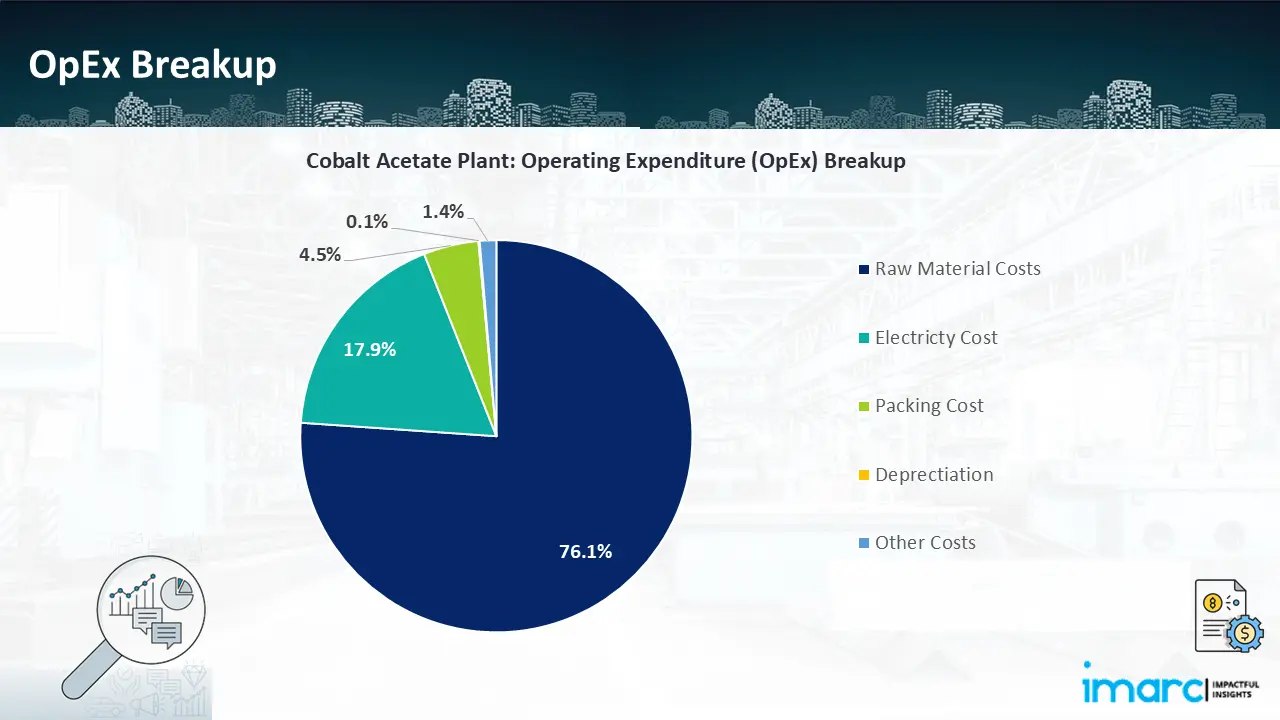
- Operating Expenditure (OpEx): Operating expenditure is the cost incurred to operate a manufacturing plant effectively. OpEx in a manufacturing plant typically includes the cost of raw materials, utilities, depreciation, taxes, packing cost, transportation cost, and repairs and maintenance. The operating expenses are part of the cost structure of a manufacturing plant and have a significant effect on profitability and efficiency. Effective control of these costs is necessary for maintaining competitiveness and growth.
- Profitability Analysis Year on Year Basis: The proposed cobalt acetate plant, with a capacity of 3,000 tons of cobalt acetate annually, achieved an impressive revenue of INR 3,488 million in its first year. We assisted our client in developing a detailed cost model, which projects steady growth, with revenue growing throughout the forecasted period. Moreover, gross profit improved slightly from 31.7% to 31.8%, and net profit rise from 20.5% to 20.6%, highlighting strong financial viability and operational efficiency.

Conclusion & IMARC's Impact:
Our cobalt acetate manufacturing plant's financial model was meticulously modelled to satisfy the client's requirements. It provided a thorough analysis of production costs including capital expenditures, manufacturing processes, raw materials, and operating costs. The model predicts profitability while accounting for market trends, inflation, and any shifts in the price of raw materials. It was created especially to satisfy the demand of producing 3,000 tons of cobalt acetate annually. Our commitment to offering precise, client-cantered solutions that ensure the long-term success of significant industrial projects by giving the client useful data for strategic decision-making is demonstrated by this comprehensive financial model.Latest News and Developments:
- In May 2022, Jervois Finland announced plans to expand its capacity for processing cobalt from 6,250 metric tonnes per year (mtpa) to 12,250 mtpa. By concentrating on cobalt sulphate production, this development seeks to satisfy the increasing demand, especially in the electric vehicle (EV) industry. To accomplish this growth, the business plans to make use of its current infrastructure and knowledge.
Why Choose IMARC:
IMARC's Financial Model Expertise: Helping Our Clients Explore Industry Economics
IMARC is a global market research company that offers a wide range of services, including market entry and expansion, market entry and opportunity assessment, competitive intelligence and benchmarking, procurement research, pricing and cost research, regulatory approvals and licensing, factory setup, factory auditing, company incorporation, incubation services, recruitment services, and marketing and sales.Brief List of Our Services: Market Entry and Expansion
- Market Entry and Opportunity Assessment
- Competitive Intelligence and Benchmarking
- Procurement Research
- Pricing and Cost Research
- Sourcing
- Distribution Partner Identification
- Contract Manufacturer Identification
- Regulatory Approvals, and Licensing
- Factory Setup
- Factory Auditing
- Company Incorporation
- Incubation Services
- Recruitment Services
- Marketing and Sales
Under our factory setup services, we assist our clients in exploring the feasibility of their plants by providing comprehensive financial modeling. Additionally, we offer end-to-end consultation for setting up a plant in India or abroad. Our financial modeling includes an analysis of capital expenditure ౠ(CapEx) required to establish the manufacturing facility, covering costs such as land acquisition, building infrastructure, purchasing high-tech production equipment, and installation. Furthermore, the layout and design of the factory significantly influence operational efficiency, energy consumption, and labor productivity, all of which impact long-term operational expenditure (OpEx). So, every parameter is covered in the analysis.
At IMARC, we leverage our comprehensive market research expertise to support companies in every aspect of their business journey, from market entry and expansion to operational efficiency and innovation. By integrating our factory setup services with our deep knowledge of industry dynamics, we empower our clients to not only establish manufacturing facilities but also strategically position themselves in highly competitive markets. Our financial modeling and end-to-end consultation services ensure that clients can explore the feasibility of their plant setups while also gaining insights into competitors' strategies, technological advancements, and regulatory landscapes. This holistic approach enables our clients to make informed decisions, optimize their operations, and align with sustainable practices, ultimately driving long-term success and growth.Our Clients










Contact Us
Have a question or need assistance?
Please complete the form wiꦬth your inquiry or reach out to us at
🐻
+1-201-971-6302
+44-753-714-6104
Previous Post
