Silk Reeling Unit Manufacturing Cost Analysis: Natural Fiber Processing Economics

What is Silk Reeling Unit?
A silk reeling unit is a type of manufacturing plant where raw silk threads are obtained from the cocoons of silkworm moths and processed into raw silk yarn by weaving them into a continuous strand of raw silk. The process at a silk reeling unit includes boiling the cocoons in hot water, identifying the ends of these threads, and then extracting multiple threads at the same time to create a single strand of raw silk of a specific thickness. Hence, silk reeling units can be manual, semiautomatic, or fully automatic depending on the scale of production and quality requirements. The main aim of silk reeling units is to provide raw silk that can be processed for any related textile applications.
Key Applications Across Industries:
The silk reeling units form a pivotal part of the silk value chain, as raw silk yarn is provided to various other industries. The main use of reeled silk yarn is in the textile and clothing industry, where it is woven or knitted into fabric that is required for making clothes such as saris, dresses, scarves, ties, blouses, and up-market clothing. The smoothness, strength, and luster of reeled silk make it ideal for use in up-market textiles.The silk yarn produced from the reeling units in the handloom and powerloom sectors is employed in the manufacture of traditional textiles, brocades, jacquards, and blends. These manufactured textiles find extensive applications in ceremonial dresses, traditional clothes, and heritage pro൲ducts. The silk reeling units also aid in embroidery and textile decoration by providing quality silk threads for these processes.
Apart from clothing, silk yarn can be utilized for home furnishings such as curtains, upholstery, cushion covers, and wall hangings, keeping in mind the decorative qualities and endurance required. Furthermore, silk reeling plants also provide other by-products through which silk waste and defective cocoons are converted into silk yarn, called spun silk, and then applied in carpet-making, shawls, insulation, and handicrafts. Silk fibres have specialized uses in the biomedical and cosmetic industries because of their strength and biocompatibility. All things considered, silk reeling units make it possible to create value in a variety of industries, including fashion, furniture, crafts, and specialized industrial applications.What the Expert Says: Market Overview & Growth Drivers
The global silk market reached a value of USD 21.3 Billion in 2025. According to IMARC Group, the market is projected to reach USD 37.8 Billion by 2034, at a projected CAGR of 6.36% during 2026-2034. The global silk reeling unit market is fueled by steady demand for natural, high-quality, and sustainable cotton-based textiles. The exclu💜sive attributes and requirements of silk, including its natural gloss, suppleness, durability, and biodegradability, make it a top-of-the-line luxury material for the global fashion and lifestyle segment. Also, the rising awareness about sustainable♏ and eco-friendly products drives the end-use demand for silk and consequently for silk reeling units.
The growth in the fashion and textile industry is one of the key driving factors. An increasing demand for high-end fashion garments, ethnic wear, and designer textile products boosts demand for high-quality raw silk. Up-gradation of lifestyle in emerging markets leads to an increased spending pattern on silk garments, especially for cultural and socio-religious events. Government assistance for sericulture and rural job creation is another factor that supports the market. In the regions where silk is produced, the reeling of silk is encouraged as a small and medium-scale business that generates rural jobs. Government assistance and skill development programs help create reeling units, covering the costs and upgrading technology. Export-oriented demand is also a catalyst for growth. Raw silk and silk fabrics are exported, and it is necessary that a consistent quality of yarn is achieved. Investment in technologies that improve reeling machines and quality control is thus encouraged. Innovations like automatic reeling machines enhance productivity, reduce labor dependency, and improve yarn uniformity. Diversification into silk home furnishings, handicrafts, and niche industrial uses also supports the expansion of silk production. In concert, premiumization trends, preferences for sustainability, supportive government initiatives, export demand, and advances in technology all drive global growth in silk reeling unit manufacturing.
Case Study on Cost Model of Silk Reeling Unit Manufacturing Plant
Objective
One of our clients reached out to us to conduct a feasibility study for setting up a medium scale silk reeling unit manufacturing plant.
IMARC Approach: Comprehensive Financial Feasibility
We developed a comprehensive financial model for the setup and operation of a proposed silk reeling unit manufacturing plant in India. This plant is designed to manufacture 20 MT of raw silk per year of silk reeling unit annually.Manufacturing Process: A series of meticulously regulated procedures are used in the production of a silk reeling unit in order to extract continuou♋s silk filaments from silkworm cocoons and transform them into consistent raw silk yarn. Since cocoon quality directly affects yarn strength and appearance, the process starts with the selection and grading of cocoons based on size, shell ratio, and filament length. The natural glue that links the silk strands, sericin, is then dissolved by cooking or softening certain cocoons in boiling water.
The cocoons are brushed to find the free filament ends once they have softened. A single silk thread of the necessary denier is then created by combining and reeling together many filaments, usually from multiple cocoons. Depending on the manufacturing quantity and quality requirements, reeling machines, which might be manual, cottage-basin, or motorized multi-end machines, are used to do this reeling procedure. Tension and speed are carefully regulated during reeling to guarantee consistent thickness and reduce filament breaking. In order to strengthen filament cohesiveness and eliminate superfluous moisture, the reeled silk thread goes through a twisting and drying cycle. To keep the yarn smooth and consistent, it is continuously wound into reels under carefully monitored circumstances. Throughout the process, quality tests are carried out to keep an eye on filament integrity, denier variation, and cleanliness. The raw silk is conditioned, examined, and rated according to lustre, strength, and consistency after reeling is finished. In order to avoid moisture absorption and damage, the completed silk reels are subsequently packaged and kept in appropriate storage. To create premium raw silk fit for textile production, the procedure places a strong emphasis on accuracy, cleanliness, and quality control.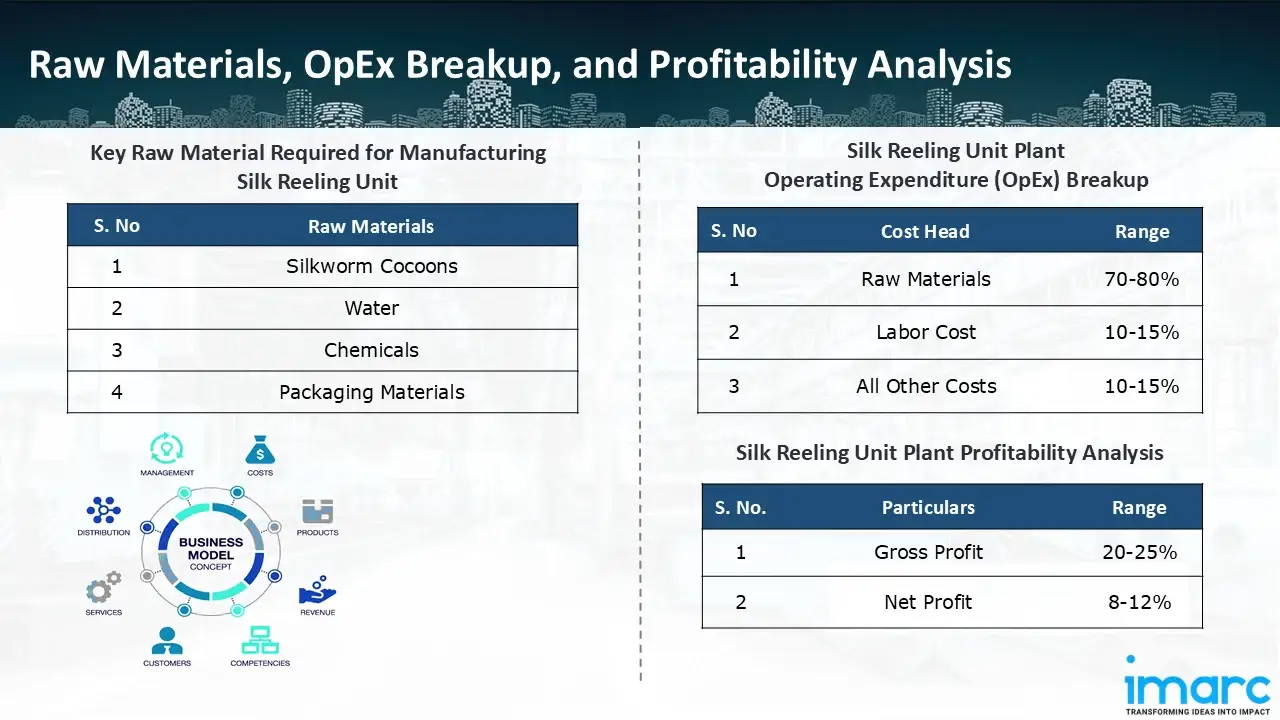
Get a Tailored Feasibility Report for Your Project Request Sample
Raw Material Required:
The basic raw materials required for silk reeling unit manufacturing include:- Silkworm Cocoons
- Water
- Chemicals
- Packaging Materials
Machine Section or Lines Required:
- Cocoon Sorting
- Cooking
- Reeling
- Re-reeling
- Drying
- Packing
Techno-Commercial Parameter:
- Capital Expenditure (CapEx): Capital expenditure (CapEx) in a manufacturing plant includes various investments essential for its setup and long-term operations. It covers machinery and equipment costs, including procurement, installation, and commissioning. Civil works expenses involve land development, factory construction, and infrastructure setup. Utilities such as power, water supply, and HVAC systems are also significant. Additionally, material handling systems, automation, environmental compliance, and safety measures are key components. Other expenditures include IT infrastructure, security systems, and office essentials, ensuring operational efficiency and business growth.
- Operating Expenditure (OpEx): Operating expenditure is the cost incurred to operate a manufacturing plant effectively. OpEx in a manufacturing plant typically includes the cost of raw materials, utilities, depreciation, taxes, packing cost, transportation cost, and repairs and maintenance. The operating expenses are part of the cost structure of a manufacturing plant and have a significant effect on profitability and efficiency. Effective control of these costs is necessary for maintaining competitiveness and growth. Furthermore, raw material cost in silk reeling unit manufacturing plant ranges between 70-80%, labor cost ranges between 10% to 15%, and all other costs ranges between 10-15% in the proposed plant.
- Profitability Analysis Year on Year Basis: We assisted our client in developing a detailed cost model, which projects steady growth, with revenue rising throughout the projected period. Moreover, gross profit margins lie between a range of 20-25%, and net profit lie between the range of 8-12% during the income projection years, highlighting strong financial viability and profitability.
Conclusion & IMARC's Impact:
Our financial model for the silk reeling unit manufacturing plant was meticulously developed to meet the client’s objectives, providing an in-depth analysis of production costs, including raw materials, manufacturing, capital expenditure, and operational expenses. By addressing the specific requirements of manufacturing 20 MT of raw silk annually, we successfully identified key cost drivers and projected profitability, considering market trends, inflation, and potential fluctuations in raw material prices. This comprehensive financial model equipped the client with valuable insights into strategic decision-making, demonstrating our commitment to delivering high-quality, client-focused solutions that ensure the long-term success of large-scale manufacturing ventures.Latest News and Developments:
- In November 2025, the Ministry of Textiles recently wrapped off its multi-sectoral engagement with Georgia with a high-level delegation. The five-day tour was done with the goal of enhancing collaboration in the carpet, clothing, textile, and sericulture industries.
- In April 2025, one of the most noteworthy accomplishments and success stories of India's textile industry in 2025, according to the Union Ministry of Textiles, is the Geographical Indication (GI) designation given to Meghalaya's traditional fabric, "ryndia." The nation's silk and sericulture industries saw substantial growth during what was dubbed the "Year of Textile Reforms."
Why Choose IMARC?
IMARC's Financial Model Expertise: Helping Our Clients Explore Industry Economics
IMARC is a global market research company that offers a wide range of services, including market entry and expansion, market entry and opportunity assessment, competitive intelligence and benchmarking, procurement research, pricing and cost research, regulatory approvals and licensing, factory setup, factory auditing, company incorporation, incubation services, recruitment services, and marketing and sales. Under our factory setup services, we assist our clients in exploring the feasibility of their plants by providing comprehensive financial modeling. Additionally, we offer end-to-end consultation for setting up a plant in India or abroad. Our financial modeling includes an analysis of capital expenditure (CapEx) required to establish the manufacturing facility, covering costs such as land acquisition, building infrastructure, purchasing high-tech production equipment, and installation. Furthermore, the layout and design of the factory significantly influence operational efficiency, energy consumption, and labor productivity, all of which impact long-term operational expenditure (OpEx). So, every parameter is covered in the analysis. At IMARC, we leverage our comprehensive market research expertise to support companies in every aspect of their business journey, from market entry and expansion to operational efficiency and innovation. By integrating our factory setup services with our deep knowledge of industry dynamics, we empower our clients to not only establish manufacturing facilities but also strategically position themselves in highly competitive markets. Our financial modeling and end-to-end consultation services ensure that clients can explore the feasibility of their plant setups while also gaining insights into competitors' strategies, technological advancements, and regulatory landscapes. This holistic approach enables our clients to make informed decisions, optimize their operations, and align with sustainable practices, ultimately driving long-term success and growth.Our Clients










Contact Us
Have a question or need assistance?
Please𒐪 complete the form with your inquiry or reach out to us at
+1-201-971-6302
+44-753-714-6104
Previous Post
