Hydrogen Manufacturing Cost Analysis: Process & Cost Engineering Report

What is Hydrogen?
Hydrogen is the lightest and most abundant element in the universe, being a colorless, odorless, highly combustible gas. It does not usually occur free in nature but is produced from hydrogen-rich compounds like water, natural gas, biomass, or other hydrocarbons. Owing to its high energy content per unit mass and clean combustion (with the production of water vapor only), hydrogen is widely recognized as a versatile energy carrier. Depending on how hydrogen is produced, it is classified as grey, blue, or green and increasingly plays a significant role in clean energy systems, industrial processing, and developing low-carbon technologies.
Key Applications Across Industries:
Hydrogen has a wide application in industries, transportation, energy, and chemicals. Some of the major uses of hydrogen in industrial processing are to produce ammonia, mainly for fertilizers; petroleum refining, including hydrocracking and desulfurization; and methanol production. All of these processes require high-purity hydrogen, making it one🙈 of the fundamentals to global chemical and petrochemical industries. In the steel industry, hydrogen increasingly acts as a reducing agent in a DRI plant. This is enabling low-carbon ꧋steelmaking and replacing coal in this process.
In the energy sector, hydrogen is a clean fuel that can be used in power generation and for energy storage. Hydrogen can be blended with natural gas or used in hydrogen turbines to provide firm, dispatchable electricity. Hydrogen enables long-duration energy storage, providing stability to grids with high renewable penetration. In transport, hydrogen is used to power FCEVs, such as buses, trucks, trains, forklifts, and marine vessels, and in the longer term, aviation fuel systems. Hydrogen is then transformed into electricity in fuel cells, which allows fast refueling and long range for heavy-duty mobility. Hydrogen can be used instead to produce synthetic fuels, such as e-methanol, e-diesel, and sustainable aviation fuel. Hydrogen will also be used for the production of green chemicals, hydrogen-powered heat, and decarbonized industrial heat in industries where electrification is particularly hard to implement. All in all, versatility makes hydrogen indispensable in future decarbonized energy systems.What the Expert Says: Market Overview & Growth Drivers
The global hydrogen market reached a value of USD 201.44 Billion in 2025. According to IMARC Group, the market is projected to reach USD 308.50 Billion by 2034, at a projected CAGR of 4.85% during 2026-2034. Decarbonization policy, industrial transition, technology development, and large-scale renewable energy deployment are combining to reshape the global hydrogen market. Perhaps the most powerful driver is the linked global ambition for net zer✨o, as a growing number of countries develop hydroge♑n roadmaps and incentivize low-carbon hydrogen supply. For industries looking at ways to decrease fossil fuel use, hydrogen presents a clean alternative, especially in production via renewable-powered electrolysis.
Another major driver is the need to decarbonize hard-to-abate sectors such as steelmaking, cement, chemicals, oil refining, fertilizer production, and heavy transport. These industries require high-temperature heat, chemical feedsto🏅cks, or long-distance energy carriers-roles hydro🎐gen can fill more effectively than direct electrification. As companies adopt emission reduction targets, hydrogen will be central to industrial transformation.
Competitively priced green hydrogen production is supported by the expanding availability of low-cost renewable energy, particularly solar and wind. This has driven renewable-rich regions to position themselves as future hydrogen exporters by developing large-scale electrolysis projects and various hydrogen derivatives such as green ammonia and𓄧 methanol.
Technological advances in electrolyzers, fuel cells, carbon capture, storage solutions, and hydrogen storage materials are generally reducing production costs while improving energy efficiency, further driving adoption. Investment in hydrogen infrastructure-pipelines, liquefaction plants, refueling stations, shipping terminals-is the means to achieve market scalability. Geopolitical objectives of improving energy security and diversification of energy sources also play an important role. Countries are increasingly viewing hydrogen as a strategic energy commodity that would sharply reduce dependency on imported fossil fuels. Combined, these factors position hydrogen as a cornerstone of global clean energy strategies, industrial decarbonization pathways, and next-generation transportation systems.
Case Study on Cost Model of Hydrogen Manufacturing Plant:
Objective
One of our clients reached out to us to conduct a feasibility study for setting up a medium scale hydrogen manufacturing plant.IMARC Approach: Comprehensive Financial Feasibility
We developed a comprehensive financial model for the setup and operation of a proposed hydrogen manufacturing plant in India. This plant is designed to manufacture 300 tons of hydrogen annually.Manufacturing Process: Hydrogen manufacturing, depending on feedstock and technology, encompasses various production routes; most of them involve the separation of hydrogen from hydrogen-containing compounds, such as natural gas, water, or biomass. One of the main methods widely used is SMR, wherein the feedstock natural gas reacts over a nickel catalyst with high-temperature steam in the range of 700–1,000°C to produce hydrogen and carbon monoxide. The carbon monoxide produced then undergoes a water–gas shift reaction, where more hydrogen and carbon dioxide are produced from steam. The resultant gas mixture then passes💃 through purification systems, usually PSA, which isolates high-purity hydrogen. If this process is combined with CCS, then such hydrogen derived from SMR is labeled as blue hydrogen. Another production method is electrolysis for making green hydrogen, wherein electricity—ideally from renewable sources—acts on water in an electrolyzer to split it into hydrogen and oxygen. Types of electrolyzers include alkaline, PEM (proton exchange membran♚e), and solid oxide electrolyzers, where each works at different temperatures and efficiencies. Alkaline systems are robust and mature, PEM allows high-purity output and flexible operation, while solid oxide units work at high temperatures to improve energy efficiency. Hydrogen production is also possible through ATR, which integrates partial oxidation and steam reforming in one process step, having high hydrogen yields with efficient carbon capture integration. Biomass gasification is another pathway; it involves heating organic material with limited oxygen, producing syngas from which hydrogen is extracted through further processing. After production, hydrogen is subjected to drying, then purification, and subsequently compression or liquefaction, depending on its application. This ensures that the final product will meet the quality specifications for various industrial processes, fuel cells, chemical synthesis, and energy applications.
Get a Tailored Feasibility Report for Your Project DB真人旗舰·集团:Request Sample
Raw Material Required:
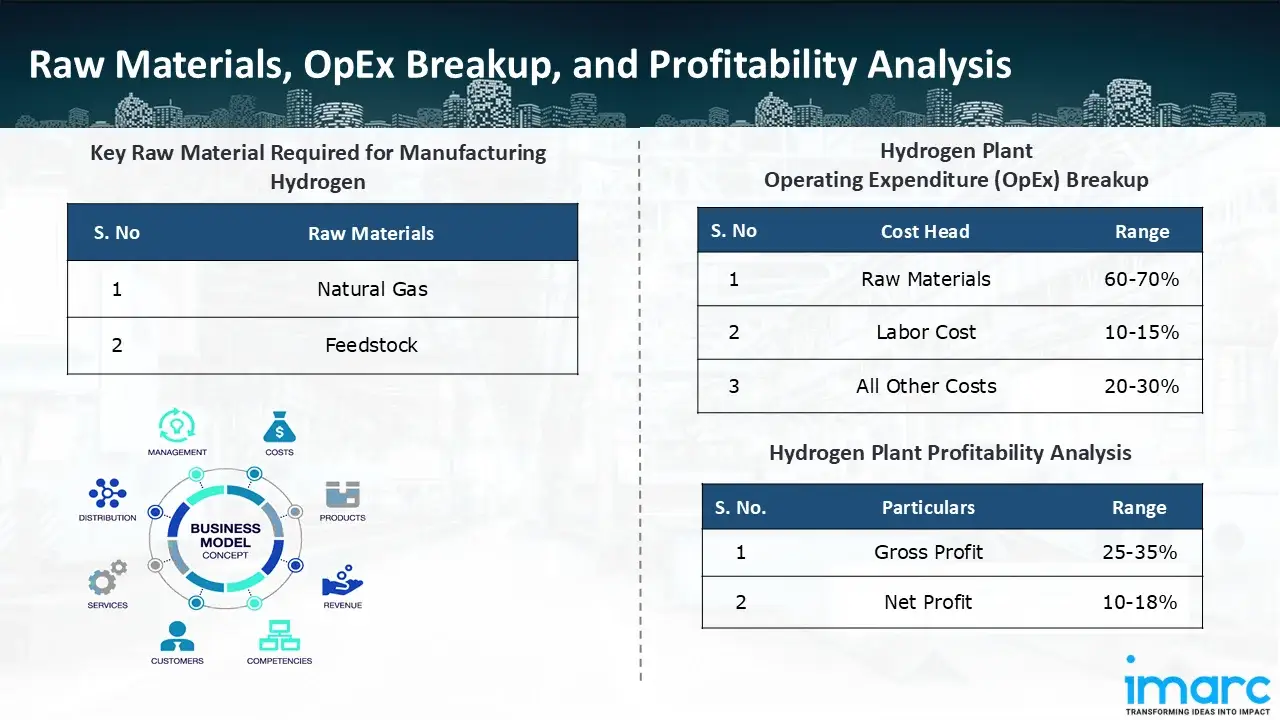
The basic raw materials required for hydrogen manufacturing include:- Natural Gas
- Feedstock
Machine Section or Lines Required:
- Steam Methane Reformer (SMR)
- Purification
- Compression
Techno-Commercial Parameter:
- Capital Expenditure (CapEx): Capital expenditure (CapEx) in a manufacturing plant includes various investments essential for its setup and long-term operations. It covers machinery and equipment costs, including procurement, installation, and commissioning. Civil works expenses involve land development, factory construction, and infrastructure setup. Utilities such as power, water supply, and HVAC systems are also significant. Additionally, material handling systems, automation, environmental compliance, and safety measures are key components. Other expenditures include IT infrastructure, security systems, and office essentials, ensuring operational efficiency and business growth.
- Operating Expenditure (OpEx): Operating expenditure is the cost incurred to operate a manufacturing plant effectively. Opex in a manufacturing plant typically includes the cost of raw materials, utilities, depreciation, taxes, packing cost, transportation cost, and repairs and maintenance. The operating expenses are part of the cost structure of a manufacturing plant and have a significant effect on profitability and efficiency. Effective control of these costs is necessary for maintaining competitiveness and growth. Furthermore, raw material cost in hydrogen manufacturing plant ranges between 60-70%, labor cost ranges between 10% to 15%, and all other costs ranges between 20-30% in the proposed plant.
- Profitability Analysis Year on Year Basis: We assisted our client in developing a detailed cost model, which projects steady growth, with revenue rising throughout the projected period. Moreover, gross profit margins lie between a range of 25-35%, and net profit lie between the range of 10-18% during the income projection years, highlighting strong financial viability and profitability.
Conclusion & IMARC's Impact:
Our financial model for the hydrogen manufacturing plant was meticulously developed to meet the client’s objectives, providing an in-depth analysis of production costs, including raw materials, manufacturing, capital expenditure, and operational expenses. By addressing the specific requirements of manufacturing 300 tons of hydrogen annually, we successfully identified key cost drivers and projected profitability, considering market trends, inflation, and potential fluctuations in raw material prices. This comprehensive financial model equipped the client with valuable insights into strategic decision-making, demonstrating our commitment to delivering high-quality, client-focused solutions that ensure the long-term success of large-scale manufacturing ventures.Latest News and Developments:
- In June 2025, Adani New Industries Limited (ANIL) announced the successful commissioning of India's first off-grid 5 MW Green Hydrogen Pilot Plant in Kutch, Gujarat. The cutting-edge facility can run entirely off the grid thanks to its integration of a Battery Energy Storage System (BESS) and 100% solar electricity. This is a novel approach to the decentralised manufacturing of hydrogen using renewable energy.
- In May 2025, a Memorandum of Understanding (MoU) for the joint development of a green hydrogen and ammonia export facility at Mulapeta Port in Andhra Pradesh with a budgeted investment of US$ 1.3 billion (INR 10,000 crore) has been inked between Juno Joule Green Energy Pvt Ltd and Germany-based Select Energy GmbH.
- In April 2025, as part of a new green hydrogen value chain, Eastern German gas provider VNG, which is mostly controlled by utility EnBW (EBKG.DE), announced on Wednesday that it will begin test operations at a 30 megawatt (MW) electrolysis facility in the third quarter of 2025.
Why Choose IMARC?
IMARC's Financial Model Expertise: Helping Our Clients Explore Industry Economics
IMARC is a global market research company that offers a wide range of services, including market entry and expansion, market entry and opportunity assessment, competitive intelligence and benchmarking, procurement research, pricing and cost research, regulatory approvals and licensing, factory setup, factory auditing, company incorporation, incubation services, recruitment services, and marketing and sales. Under our factory setup services, we assist our clients in exploring the feasibility of their plants by providing comprehensive financial modeling. Additionally, we offer end-to-end consultation for setting up a plant in India or abroad. Our financial modeling includes an analysis of capital expenditure (CapEx) required to establish the manufacturing facility, covering costs such as land acquisition, building infrastructure, purchasing high-tech production equipment, and installation. Furthermore, the layout and design of the factory significantly influence operational efficiency, energy consumption, and labor productivity, all of which impact long-term operational expenditure (OpEx). So, every parameter is covered in the analysis. At IMARC, we leverage our comprehensive market research expertise to support companies in every aspect of their business journey, from market entry and expansion to operational efficiency and innovation. By integrating our factory setup services with our deep knowledge of industry dynamics, we empower our clients to not only establish manufacturing facilities but also strategically position themselves in highly competitive markets. Our financial modeling and end-to-end consultation services ensure that clients can explore the feasibility of their plant setups while also gaining insights into competitors' strategies, technological advancements, and regulatory landscapes. This holistic approach enables our clients to make informed decisions, optimize their operations, and align with sustainable practices, ultimately driving long-term success and growth.Our Clients









Contact Us
Have a question or need assistance?
Please complete the for🌄m with your inquiry or reach out to us at
+1-201-971-6302
+44-753-714-6104
Previous Post
