Steel Bolts and Fasteners Cost Model: From Metal Forging to Structural Value
_11zon.webp)
What is Steel Bolts and Fasteners?
Steel bolts and fasteners are integral mechanical components that provide secure connections across industrial, commercial, and household applications. Comprising primarily of carbon steel, alloy steel, or stainless steel, these fasteners are engineered to withstand significant mechanical loads, torque, and environmental exposure.
Key Applications Across Industries:
Their key properties include high tensile strength, corrosion resistance, dimensional precision, and durability under cyclic stress. Manufacturing typically involves processes such as forging, machining, threading, and surface finishing to meet exacting industry standards. Applications are diverse, spanning construction, automotive, aerospace, machinery, infrastructure, and consumer goods, where reliability and safety are paramount. Advantages include versatility across load-bearing and non-load-bearing functions, ease of installation, and compatibility with multiple materials such as wood, metals, and composites. From a sustainability standpoint, steel fasteners are recyclable and offer long lifecycle performance, reducing the need for frequent replacements. Their economic value lies in being cost-effective yet essential in nearly every engineering assembly. Looking ahead, demand will be driven by megaprojects in infrastructure, electric vehicles, renewable energy installations, and precision engineering, positioning steel bolts and fasteners as critical enablers of industrial growth and sustainable construction.What the Expert Says: Market Overview & Growth Drivers
The global steel bolts and fasteners market size reached USD 78.7 Billion in 2025. According to IMARC Group, the market is projected to reach USD 108.8 Billion by 2034, at a projected CAGR of 3.55% during 2026-2034. The market for steel bolts and fasteners is underpinned by perennia꧅l drivers such as construction activity, automotive production, machinery manufacturing, shipbuilding, and aerospace engineer♏ing.
Infrastructure development in emerging economies continues to propel demand, while the automotive industry increasingly relies on precision fasteners for electric vehicle assembly and lightweighting initiatives. Machinery and equipment manufacturing also remain a strong consumption base, where fasteners ensure mechanical reliability. Key futuristic trends include the integration of smart fasteners equipped with sensors for predictive maintenance, increased adoption of high-performance coatings for corrosion protection, and demand for lightweight alloy-based fasteners in aerospace. Competitive advantages include high strength-to-weight ratios, recyclability, and standardized global production norms. However, challenges such as volatility in steel prices and stringent quality certifications pose risks. From a sustainability perspective, circular economy initiatives are encouraging the recycling of steel fasteners, while manufacturers are adopting energy-efficient heat treatment and coating processes. Industry players are responding by investing in automation, robotics, and Industry 4.0-enabled production lines to enhance productivity, quality consistency, and environmental compliance.Case Study on Cost Model of Steel Bolts and Fasteners Manufacturing Plant:
Objective
One of our clients reached out to us to conduct a feasibility study for setting up a medium-to-large-scale steel bolts and fasteners manufacturing plant.IMARC Approach: Comprehensive Financial Feasibility
We developed a comprehensive financial model for the setup and operation of a proposed steel bolts and fasteners manufacturing plant in Zimbabwe. This plant is designed to produce 345 tons of MS steel bolts, 116 tons of MS steel nuts, 40 tons of MS steel flat washers, 345 tons of high tensile bolts, 116 tons of high tensile nuts, and 40 tons high tensile flat washers per year.Manufacturing Process: The manufacturing of steel bolts and fasteners begins with raw material preparation, primarily steel wire rods or bars, which are cleaned and coated for ease of further processing. The material is cut into required lengths and subjected to cold or hot forging to shape the bolt head and body. Threading is performed using rolling or cutting techniques to ensure accurate pitch and strength. Intermediate treatments, such as heat treatment, hardening, and tempering, enhance mechanical properties like tensile strength and toughness. Cleaning processes involve pickling, surface blasting, and degreasing to eliminate scale and residues. Quಞality control is crit﷽ical and includes dimensional checks, tensile and hardness testing, torque tests, and non-destructive evaluations. Surface treatments such as galvanizing, zinc plating, phosphate coating, or specialized anti-corrosion finishes are applied to extend lifecycle and meet application-specific requirements. Finally, the fasteners are sorted, sized, packaged, and dispatched for end-use applications across automotive, aerospace, construction, and industrial equipment sectors.
_11zon.webp)
Mass Balance and Raw Material Required: The primary raw material used in the MS steel and high tensile bolts producing plant is steel rod. For a plant pro🍬ducing 1 ton of MS steel and high tensile bolts, 1.09 ton of steel rod (M12), steel rod (M16), steel rod (M20), steel rod (M24), and steel rod (M30) is required.
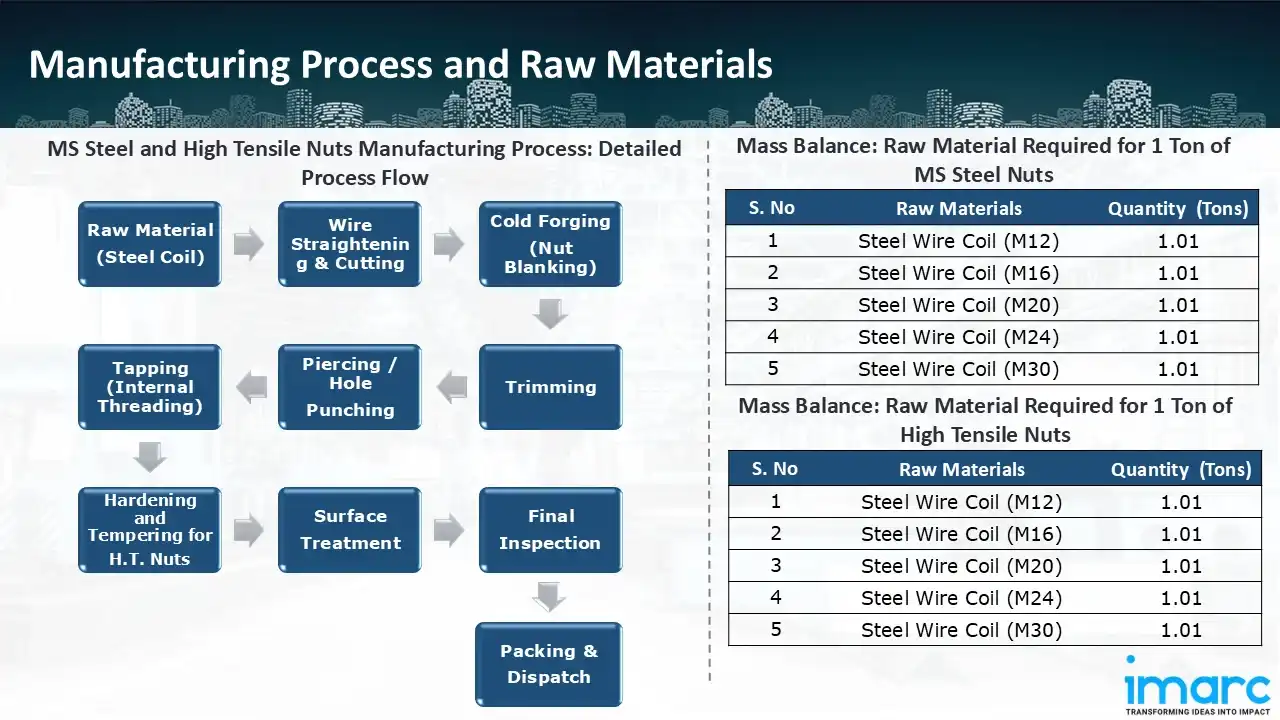
Mass Balance and Raw Material Required: The primary raw material used in the MS steel and🍃 high tensile nuts producing plant is steel wire coil. For a plant producing 1 ton of MS steel and high tensile nuts, 1.01 ton of steel wire coil (M12), steel wire coil (M16), steel wire coil (M20), steel wire coil (M24), and steel wire coil (M30) is required.

Mass Balance and Raw Material Required: The primary raw material used in the MS steel and high tensile flat washers producing plant is steel sheet. For a plant producing 1 ton of MS steel and high tensile flat washers, 1.11 ton of steel sheet (M12), 1.🌊11 ton🎶 of steel sheet (M16), 1.11 ton of steel sheet (M20), 1.11 ton of steel sheet (M24), and 1.11 ton of steel sheet (M30) is required.
Techno-Commercial Parameter:
- Capital Investment (CapEx): Capital expenditure (CapEx) in a manufacturing plant includes various investments essential for its setup and long-term operations. It covers machinery and equipment costs, including procurement, installation, and commissioning. Civil works expenses involve land development, factory construction, and infrastructure setup. Utilities such as power, water supply, and HVAC systems are also significant. Additionally, material handling systems, automation, environmental compliance, and safety measures are key components. Other expenditures include IT infrastructure, security systems, and office essentials, ensuring operational efficiency and business growth.
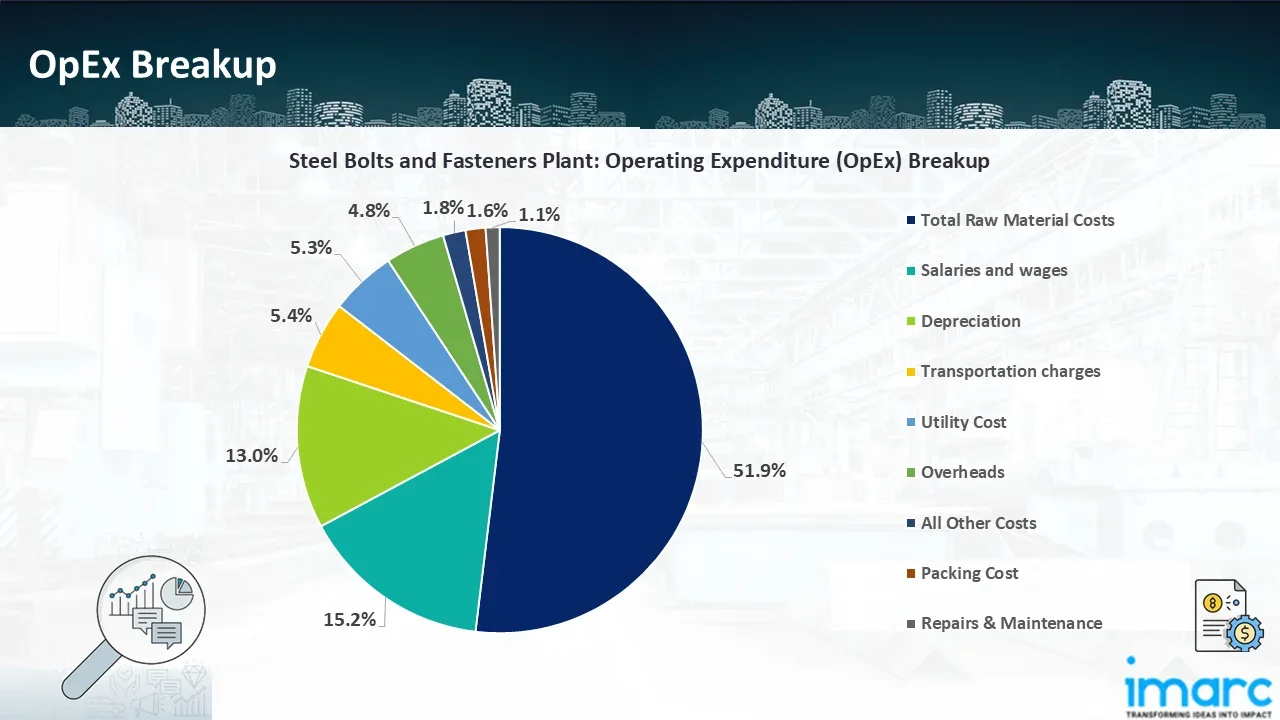
- Operating Expenditure (OpEx): Operating expenditure is the cost incurred to operate a manufacturing plant effectively. Opex in a manufacturing plant typically includes the cost of raw materials, utilities, depreciation, taxes, packing cost, transportation cost, and repairs and maintenance. The operating expenses are part of the cost structure of a manufacturing plant and have a significant effect on profitability and efficiency. Effective control of these costs is necessary for maintaining competitiveness and growth.
- Profitability Analysis Year on Year Basis: The proposed steel bolts and fasteners plant, with a capacity of 345 tons of MS steel bolts, 116 tons of MS steel nuts, 40 tons of MS steel flat washers, 345 tons of high tensile bolts, 116 tons of high tensile nuts, and 40 tons high tensile flat washers per year, achieved an impressive revenue of USD 2.37 Million in its first year. We assisted our client in developing a detailed cost model, which projects steady growth, with revenue rising throughout the projected period. Moreover, gross profit margins improve from 41.54% to 44.04% by year 10, and net profit rises from 18.55% to 29.81%, highlighting strong financial viability and profitability.

Conclusion & IMARC's Impact:
Our financial model for the steel bolts and fasteners manufacturing plant was meticulously developed to meet the client’s objectives, providing an in-depth analysis of production costs, including raw materials, manufacturing, capital expenditure, and operational expenses. By addressing the specific requirements of producing 345 tons of MS steel bolts, 116 tons of MS steel nuts, 40 tons of MS steel flat washers, 345 tons of high tensile bolts, 116 tons of high tensile nuts, and high tensile flat washers per year, we successfully identified key cost drivers and projected profitability, considering market trends, inflation, and potential fluctuations in raw material prices. This comprehensive financial model equipped the client with valuable insights into strategic decision-making, demonstrating our commitment to delivering high-quality, client-focused solutions that ensure the long-term success of large-scale manufacturing ventures.Latest News and Developments:
-
In January 2025, the Bossard Group🐼 announced that it had completed its acquisition of the Ferdinand Gro𒈔ss Group, a leading German distributor of fastening technology.
Why Choose IMARC:
IMARC's Financial Model Expertise: Helping Our Clients Explore Industry Economics
IMARC is a global market research company that offers a wide range of services, including market entry and expansion, market entry and opportunity assessment, competitive intelligence and benchmarking, procurement research, pricing and cost research, regulatory approvals and licensing, factory setup, factory auditing, company incorporation, incubation services, recruitment services, and marketing and sales. Under our factory setup services, we assist our clients in exploring the feasibility of their plants by providing comprehensive financial modeling. Additionally, we offer end-to-end consultation for setting up a plant in India or abroad. Our financial modeling includes an analysis of capital expenditure (CapEx) required to establish the manufacturing facility, covering costs such as land acquisition, building infrastructure, purchasing high-tech production equipment, and installation. Furthermore, the layout and design of the factory significantly influence operational efficiency, energy consumption, and labor productivity, all of which impact long-term operational expenditure (OpEx). So, every parameter is covered in the analysis. At IMARC, we leverage our comprehensive market research expertise to support companies in every aspect of their business journey, from market entry and expansion to operational efficiency and innovation. By integrating our factory setup services with our deep knowledge of industry dynamics, we empower our clients to not only establish manufacturing facilities but also strategically position themselves in highly competitive markets. Our financial modeling and end-to-end consultation services ensure that clients can explore the feasibility of their plant setups while also gaining insights into competitors' strategies, technological advancements, and regulatory landscapes. This holistic approach enables our clients to make informed decisions, optimize their operations, and align with sustainable practices, ultimately driving long-term success and growth.Our Clients










Contact Us
Have a question or need assistance?
Please complete the form with 🍒your inquiry 🦹or reach out to us at
+1-201-971-6302
+44-753-714-6104
Previous Post
