Precipitated Silica Production Cost Model: Particle Precision, Profitable Outcomes

What is Precipitated Silica?
Precipitated silica is a synthetic and amorphous silicon dioxide, which is prepared through a process of controlled chemical reaction between soluble silicates and mineral acids. Unlike regular silica, precipitated silica is manufactured to have desired particle sizes, surface area, and porosity in terms of its structure, determining its final end-use performance. Precipitated silica is a fine, white, and free-flowing powdered substance. It is appreciated for its applications in reinforcement, thickening, prevention of caking, and absorption. Owing to its purity and diversity in applications, precipitated silica is employed as a functional additive in various applications in the rubber industry, food industry, pharmaceutical market, and personal care industry.
Key Applications Across Industries:
The application of precipitated silica is extensive owing to its versatile properties. The major application area for precipitated silica is in the rubber sector, specifically in the manufacture of tires, wherein it serves as a filling material. Green tires and high-performance tires have incorporated precipitated silica to enhance the rolling resistance, wet traction, fuel economy, and mileage. It is also added to the non-tire rubber products category, including hoses, belts, footwear, seals, and molded rubber, to increase the mechanical properties. In the food sector, the product is utilized as a precursor to the production of anti-caking agents in powdered foods such as spices, seasonings, powdered beverages, and dietary supplements. As a drying agent and a free-flowing substance, the product is beneficial in the prevention of caking. In the pharmaceutical sector, the product is utilized as a glidant in tablet and capsule production. Personal care and cosmetics are another major use area. It acts as a mild abrasive in toothpaste to aid in cleaning and polishing without damaging the enamel. It also serves as a thickening and matting agent in creams, lotions, and make-up. In the industry, it is employed in paints, coatings, adhesives, and sealants as a viscosity modifier and a mechanical property modifier. This versatility makes precipitated silica a very valuable additive in a wide range of applications, ranging from high performance to the mass market.What the Expert Says: Market Overview & Growth Drivers
The global precipitated silica market reached a value of USD 4.45 Billion in 2025. According to IMARC Group, the market is projected to reach USD 7.26 Billion by 2034, at a projected CAGR of 5.6% during 2026-2034. Driven by th🍸e rising demand for precipitated silica in rubber, automobile, consumer, and industrial applications, along with a greater focus on performance and sustainability, is propelling the global precipitated silica market. Of these, perhaps the most prominent driver is the automobile segment, especially due to consumer demand for more fuel-efficient and high-performance tires. A prominent application of precipitated silica is enhancing tire performance attributes.
The increased use of processed and convenience food further fuels market growth. As food processors strive to enhance food stability and ease of use, the use of effective anti-caking agents like precipitated silica also fuels growth. The growth of the pharmaceutical and nutraceutical industries further fuels market growth, as formulation control and performance are essential in these industries. The market for personal care and cosmetics is another major growth contributor. The rising consumer awareness level regarding oral care and cosmetic performance creates demand for precipitated silica. The compatibility level of precipitated silica with clean labels and safety aspects is increasing its acceptance globally. Growth in industries like construction, coatings, and adhesives is another factor driving demand for precipitated silica. This is because precipitated silica enhances properties like rheology, durability, and reinforcement in these sectors, pushing its application in high-end products. Moreover, technological developments in processing help manufacturers produce precipitated silica for specific applications. Other environmental and regulatory considerations also impact the market. As industries continue to pursue efficiency, durability, and weight reduction, the performance-enhancing and lightweighting capabilities of precipitated silica become even more desirable. As various industries pursue innovations related to efficiency and performance-enhancing formulations, demand continues to be driven for its Production.
Case Study on Cost Model of Precipitated Silica Production Plant:
Objective
One of our clients reached out to us to conduct a feasibility study for setting up a medium scale precipitated silica production plant.
IMARC Approach: Comprehensive Financial Feasibility
We developed a comprehensive financial model for the setup and operation of a proposed precipitated silica production plant in India. This plant is designed to produce 20,000 tons of precipitated silica annually.Production Flow: The production process of precipitated silica entails a chemical precipitation process that is precisely carried out with the aim of obtaining silica with desired physical and chemical properties. The process begins with the production of an alkaline sodium silicate solution that is generally known by the name water glass and represents the major raw material for silica production. Water glass solution is obtained by dissolving silica sand and DB真人旗舰·集团:sodium hydroxide under elevated temperatures and pressures. The concentration and purity of sodium silicate solution determine the final properties of precipitated silica. During the precipitation process, a mineral acid, usually sulfuric acid or carbon dioxide, is carefully added to the sodium silicate solution. The result of the reaction is the precipitation of silica in the form of fine particles. Various key parameters, such as pH, temperature, time, agitation, and addition rate, are carefully controlled during the precipitation process to affect the desired properties of the resultant particles of silica. The precipitation of the material is finished and then comes the aging process of the slurry of sili💛cas that developed after precipitation. The slurry is then filtered in order to separate the solid and liquid phase🤡s of the material. The material is then thoroughly washed after filtering. The purpose of the process is to remove salines and other by-products to achieve high purity. The material is then dried through spray dryers and rotary dryers based on the moisture content. The silica is then dried and ground to be classified according to the final particle distribution sizes that meet specific requirements. The silica undergoes final testing to ensure standards have been met in respect to final silica purity, appearance, or performance indicators such as surface area or oil absorption capacity, among others.
Get a Tailored Feasibility Report for Your Project DB真人旗舰·集团:Request Sample
Raw Material Required:
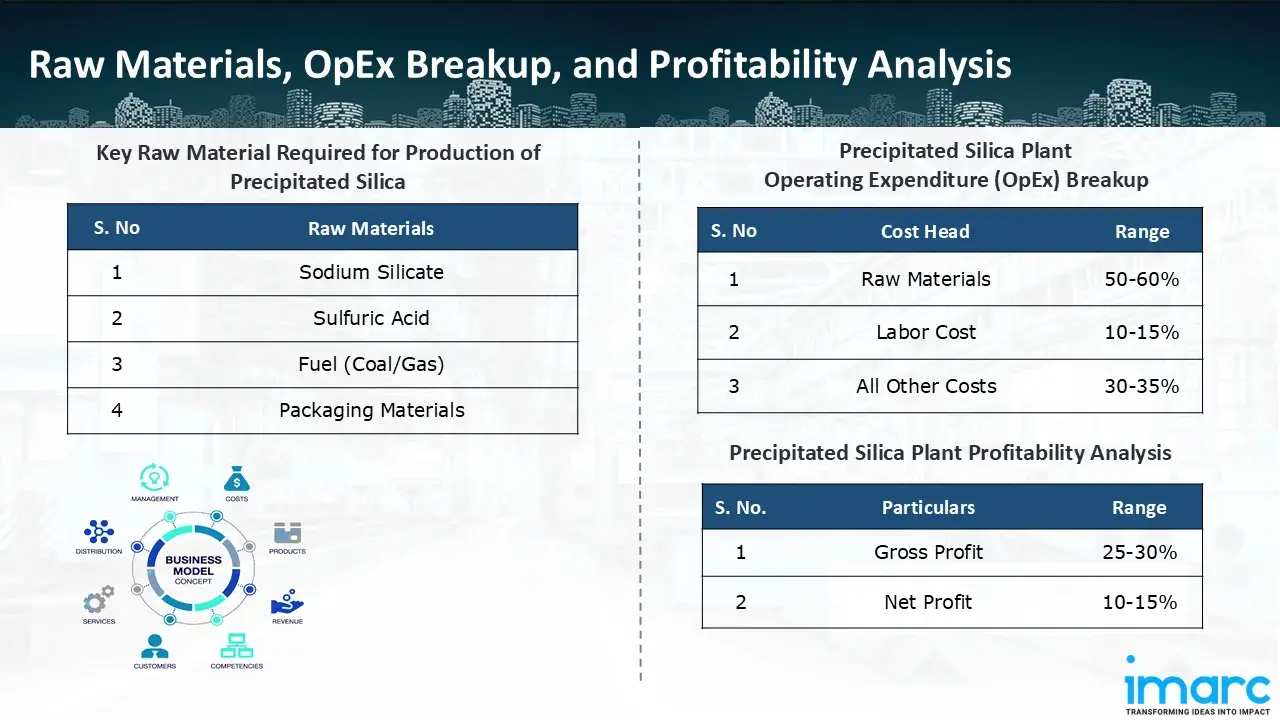
The basic raw materials required for precipitated silica production include:- Sodium Silicate
- Sulfuric Acid
- Fuel (Coal/Gas)
- Packaging Materials
Machine Section or Lines Required:
- Reaction
- Filtration
- Drying
- Milling
- Classification
- Packing
- Utilities (Boiler, ETP)
Techno-Commercial Parameter:
- Capital Expenditure (CapEx): Capital expenditure (CapEx) in a production plant includes various investments essential for its setup and long-term operations. It covers machinery and equipment costs, including procurement, installation, and commissioning. Civil works expenses involve land development, factory construction, and infrastructure setup. Utilities such as power, water supply, and HVAC systems are also significant. Additionally, material handling systems, automation, environmental compliance, and safety measures are key components. Other expenditures include IT infrastructure, security systems, and office essentials, ensuring operational efficiency and business growth.
- Operating Expenditure (OpEx): Operating expenditure is the cost incurred to operate a production plant effectively. OpEx in a production plant typically includes the cost of raw materials, utilities, depreciation, taxes, packing cost, transportation cost, and repairs and maintenance. The operating expenses are part of the cost structure of a production plant and have a significant effect on profitability and efficiency. Effective control of these costs is necessary for maintaining competitiveness and growth. Furthermore, raw material cost in precipitated silica production plant ranges between 50-60%, labor cost ranges between 10% to 15%, and all other costs ranges between 30-35% in the proposed plant.
- Profitability Analysis Year on Year Basis: We assisted our client in developing a detailed cost model, which projects steady growth, with revenue rising throughout the projected period. Moreover, gross profit margins lie between a range of 25-30%, and net profit lie between the range of 10-15% during the income projection years, highlighting strong financial viability and profitability.
Conclusion & IMARC's Impact:
Our financial model for the precipitated silica production plant was meticulously developed to meet the client’s objectives, providing an in-depth analysis of production costs, including raw materials, production, capital expenditure, and operational expenses. By addressing the specific requirements of producing 20,000 tons of precipitated silica annually, we successfully identified key cost drivers and projected profitability, considering market trends, inflation, and potential fluctuations in raw material prices. This comprehensive financial model equipped the client with valuable insights into strategic decision-making, demonstrating our commitment to delivering high-quality, client-focused solutions that ensure the long-term success of large-scale Production ventures.Latest News and Developments:
- In November 2024, PPG announced that it has sold its silica products business to QEMETICA, a privately held company situated in Warsaw, Poland that makes soda ash, silicates, and other speciality chemicals, for about US$ 310 Million in pre-tax profits.
- In October 2024, leading silica manufacturer Evonik announced the start of a major expansion at its Charleston location in Berkeley County, South Carolina. In order to meet the growing demand from the tire industry, especially for green tires in the United States, this new invention will increase the production capacity of precipitated silica by 50%.
Why Choose IMARC?
IMARC's Financial Model Expertise: Helping Our Clients Explore Industry Economics
IMARC is a global market research company that offers a wide range of services, including market entry and expansion, market entry and opportunity assessment, competitive intelligence and benchmarking, procurement research, pricing and cost research, regulatory approvals and licensing, factory setup, factory auditing, company incorporation, incubation services, recruitment services, and marketing and sales. Under our factory setup services, we assist our clients in exploring the feasibility of their plants by providing comprehensive financial modeling. Additionally, we offer end-to-end consultation for setting up a plant in India or abroad. Our financial modeling includes an analysis of capital expenditure (CapEx) required to establish the production facility, covering costs such as land acquisition, building infrastructure, purchasing high-tech production equipment, and installation. Furthermore, the layout and design of the factory significantly influence operational efficiency, energy consumption, and labor productivity, all of which impact long-term operational expenditure (OpEx). So, every parameter is covered in the analysis. At IMARC, we leverage our comprehensive market research expertise to support companies in every aspect of their business journey, from market entry and expansion to operational efficiency and innovation. By integrating our factory setup services with our deep knowledge of industry dynamics, we empower our clients to not only establish production facilities but also strategically position themselves in highly competitive markets. Our financial modeling and end-to-end consultation services ensure that clients can explore the feasibility of their plant setups while also gaining insights into competitors' strategies, technological advancements, and regulatory landscapes. This holistic approach enables our clients to make informed decisions, optimize their operations, and align with sustainable practices, ultimately driving long-term success and growth.Our Clients










Contact Us
Have a question or need assistance?
Please complete the form with 🥀your inquiry or reach out to us at
ܫ
+1-201-971-6302
+44-753-714-6104
Previous Post
