Methanol Production Cost Model: Liquid Energy Economics
What is Methanol?
Methanol, also known as methyl alcohol or wood alcohol, is a colorless liquid that is volatile and flammable with the chemical formula CH3OH. The simplest of the alcohols, it is produced mainly by the catalytic conversion process of natural gas, coal, or biomass into synthesis gas-a mixture of carbon monoxide and hydrogen-further followed by methanol synthesis under high pressure. Methanol burns cleanly, mixes easily with water, and serves as a versatile chemical building block. It has extensive uses in fuels, chemical intermediates, and various industrial applications due to its high solvency, reactivity, and energy content.
Key Applications Across Industries:
Methanol is a very versatile industrial chemical that finds wide applications in energy, production, transportation, and chemical synthesis. Its biggest use is in making formaldehyde, which in turn is used to manufacture resins, plastics, laminates, adhesives, and engineered wood products like plywood and MDF. It is also an essential feedstock for making acetic acid, methyl tert-butyl ether (MTBE), dimethyl ether (DME), and many types of solvents, coatings, and specialty chemicals. In the energy sector, methanol is increasingly employed as a cleaner-burning, alternative fuel. It can be mixed with gasoline, used in cooking stoves, or converted into biodiesel through transesterification. Its role in marine fuel continues to grow, too, as shipping companies seek out low-emission alternatives that keep sulfur oxides and particulate matter at a minimum. Methanol also plays a critical role in fuel-cell technologies, most especially in the direct-methanol fuel cells used in portable power systems. In pharmaceuticals, methanol is used as a solvent and reagent in synthesis processes. In the automotive and electronics industries, it is applied in antifreeze formulations, cleaners, and fluids for industrial processing. Methanol's wide applicability is based on its ability to act both as a chemical building block and as an energy carrier in many industrial value chains.What the Expert Says: Market Overview & Growth Drivers
The global methanol market reached a value of USD 39.6 Billion in 2025. According to IMARC Group, the market is projected to reach USD 57.3 Billion by 2034, at a projected CAGR of 4.18% during 2026-2034. The methanol market is growing, driven by increasing demand from various downstream industries, transition into new energy sources, and recently developed low-carbon methanol production technologies. Among the key end-user sectors, the continuous growth of formaldehyde-based resins, used extensively in construction, automotive i🍸nterior parts, engineered wood, and furniture production, is driving consumption forward. Apart from these, rapid urbanization and infrastructure development in Asia, the Middle East, and Latin America also lead to increased use of formaldehyde, acetic acid, and its value chain products, which directly increases thꦇe demand for methanol.
The energy sector is another major growth contributor. As governments and industries pursue cleaner fuels, methanol gains acceptance as an alternative energy carrier in marine fuel, industrial boilers, and gasoline blending. Combustion properties allow significant reductions in NOx, SOx, and particulate emissions, and therefore its use aligns with global decarbonization goals. In addition, technologies to produce MTO and MTG will allow countries with abundant coal or natural gas resources to enter the production of petrochemicals and fuel substitutes with reduced dependence on crude oil. New technologies for green methanol, manufactured from renewable hydrogen and captured CO2, point to a different future. And with shipping lines, chemical companies, and renewable-energy developers investing heavily in green methanol projects, demand should accelerate sharply as the world moves toward carbon-neutral supply chains. Additionally, volatility in crude oil markets often shifts manufacturers toward methanol-based pathways as economically favorable alternatives. Increasing investments in methanol plants, especially within China, the Middle East, and the United States, further support global capacity expansion. Altogether, a combination of industrial growth, energy diversification, and sustainability policies continues to drive strong global demand for methanol.
Case Study on Cost Model of Methanol Production Plant:
Objective
One of our clients reached out to us to conduct a feasibility study for setting up a medium scale methanol production plant.
IMARC Approach: Comprehensive Financial Feasibility
We developed a comprehensive financial model for the setup and operation of a proposed methanol production plant in India. This plant is designed to manufacture 100 tons of methanol annually.Production Process: The production of methanol in most cases starts with the conversion of a hydrocarbon feedstock-most commonly natural gas but also including coal and biomass-into synthesis gas (syngas), a mixture of hydrogen (H2), carbon monoxide (CO), and carbon dioxide (CO2). First, in natural gas–based production, the gas is treated to remove impurities that would poison catalysts. Next, it undergoes steam reforming: methane reacts with steam over a nickel catalyst at high temperatures (800–900°C) to produce syngas. Alternatively, autothermal reforming or partial oxidation may be used, especially for large-scale or coal-based plants. The compressed syngas feeds into the methanol synthesis reactor, passing over a copper-zinc-alumina catalyst under heightened pressure and at a moderate temperature of 200-300°C. The catalytic reaction between CO, CO2, and H2 produces methanol and water. The crude methanol mixture leaving the reactor contai🐟ns various impurities including higher alcohols, ketones, and dissolved gases. This mixture is cooled and condensed, and raw methanol is sent to a distillation unit for purification. Distillation generally takes place in two or more columns, removing water and volatile impurities and producing Grade AA methanol or other purity specifications, depending on the application. Iᩚᩚᩚᩚᩚᩚᩚᩚᩚ𒀱ᩚᩚᩚn newer processes for green methanol, syngas is produced either by biomass gasification or by CO2 hydrogenation using renewable hydrogen. Regardless of feedstock, in modern plants the focus is on heat recovery, energy efficiency, and emissions control in order to optimize production costs and environmental performance. The final methanol product is stored in corrosion-resistant tanks and distributed via pipelines, tankers, and drums for industrial and energy-sector use.
Get a Tailored Feasibility Report for Your Project DB真人旗舰·集团:Request Sample
Raw Material Required:
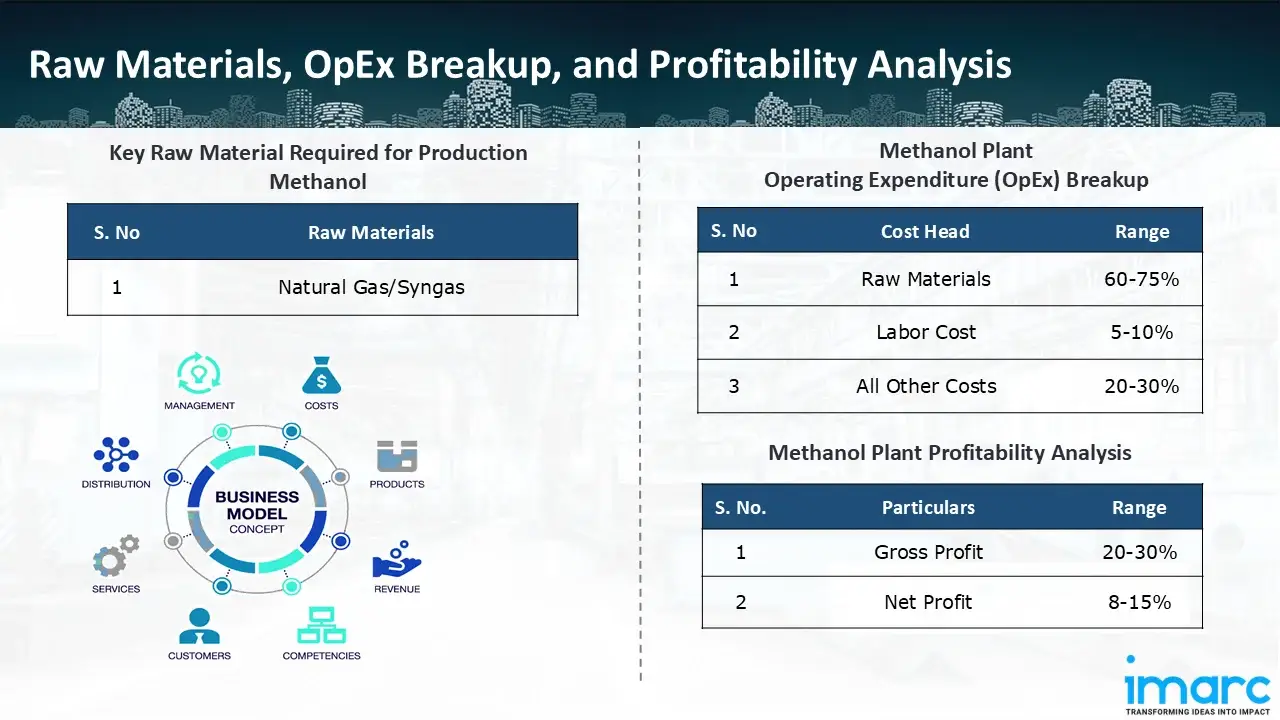
The basic raw materials required for methanol production include:- Natural Gas/Syngas
Machine Section or Lines Required:
- Reformer
- Synthesis Reactor
- Distillation
Techno-Commercial Parameter:
- Capital Expenditure (CapEx): Capital expenditure (CapEx) in a production plant includes various investments essential for its setup and long-term operations. It covers machinery and equipment costs, including procurement, installation, and commissioning. Civil works expenses involve land development, factory construction, and infrastructure setup. Utilities such as power, water supply, and HVAC systems are also significant. Additionally, material handling systems, automation, environmental compliance, and safety measures are key components. Other expenditures include IT infrastructure, security systems, and office essentials, ensuring operational efficiency and business growth.
- Operating Expenditure (OpEx): Operating expenditure is the cost incurred to operate a production plant effectively. Opex in a production plant typically includes the cost of raw materials, utilities, depreciation, taxes, packing cost, transportation cost, and repairs and maintenance. The operating expenses are part of the cost structure of a production plant and have a significant effect on profitability and efficiency. Effective control of these costs is necessary for maintaining competitiveness and growth. Furthermore, raw material cost in methanol production plant ranges between 60-75%, labor cost ranges between 5% to 10%, and all other costs ranges between 20-30% in the proposed plant.
- Profitability Analysis Year on Year Basis: We assisted our client in developing a detailed cost model, which projects steady growth, with revenue rising throughout the projected period. Moreover, gross profit margins lie between a range of 20-30%, and net profit lie between the range of 8-15% during the income projection years, highlighting strong financial viability and profitability.
Conclusion & IMARC's Impact:
Our financial model for the methanol production plant was meticulously developed to meet the client’s objectives, providing an in-depth analysis of production costs, including raw materials, production, capital expenditure, and operational expenses. By addressing the specific requirements of production 100 tons of methanol annually, we successfully identified key cost drivers and projected profitability, considering market trends, inflation, and potential fluctuations in raw material prices. This comprehensive financial model equipped the client with valuable insights into strategic decision-making, demonstrating our commitment to delivering high-quality, client-focused solutions that ensure the long-term success of large-scale production ventures.Latest News and Developments:
- In October 2025, India successfully produced its first drop of methanol made from collected carbon dioxide at NTPC's Vindhyachal Super Thermal Power Station in Madhya Pradesh, marking a major step towards industrial decarbonisation. The discovery represents a significant turning point for the carbon capture project, which is being developed in collaboration with UK-based Carbon Clean and NTPC's Energy Technology Research Alliance (NETRA).
- In March 2025, Mitsubishi Gas Chemical Company, Inc. declared that it has started building a demonstration facility for methanol production at its Mizushima Plant. The plant will use a variety of gases as raw materials, such as CO2 and gases from industrial byproducts.
- In September 2024, the international methanol division of OCI Global will be acquired by Methanex Corp. for US$2.05 billion, including assumed debt. OCI's stake in two methanol plants in Beaumont, Texas, one of which also generates ammonia, is part of the agreement.
Why Choose IMARC?
IMARC's Financial Model Expertise: Helping Our Clients Explore Industry Economics
IMARC is a global market research company that offers a wide range of services, including market entry and expansion, market entry and opportunity assessment, competitive intelligence and benchmarking, procurement research, pricing and cost research, regulatory approvals and licensing, factory setup, factory auditing, company incorporation, incubation services, recruitment services, and marketing and sales. Under our factory setup services, we assist our clients in exploring the feasibility of their plants by providing comprehensive financial modeling. Additionally, we offer end-to-end consultation for setting up a plant in India or abroad. Our financial modeling includes an analysis of capital expenditure (CapEx) required to establish the production facility, covering costs such as land acquisition, building infrastructure, purchasing high-tech production equipment, and installation. Furthermore, the layout and design of the factory significantly influence operational efficiency, energy consumption, and labor productivity, all of which impact long-term operational expenditure (OpEx). So, every parameter is covered in the analysis. At IMARC, we leverage our comprehensive market research expertise to support companies in every aspect of their business journey, from market entry and expansion to operational efficiency and innovation. By integrating our factory setup services with our deep knowledge of industry dynamics, we empower our clients to not only establish production facilities but also strategically position themselves in highly competitive markets. Our financial modeling and end-to-end consultation services ensure that clients can explore the feasibility of their plant setups while also gaining insights into competitors' strategies, technological advancements, and regulatory landscapes. This holistic approach enables our clients to make informed decisions, optimize their operations, and align with sustainable practices, ultimately driving long-term success and growth.Our Clients







Contact Us
Have a question or need assistance?
ꦆ Please complete the form with your inquiry or reach out to us at
+1-201-971-6302
+44-753-714-6104
Previous Post
