Sodium Chloride Manufacturing Cost Analysis: Essential Mineral, Measured Margins

What is Sodium Chloride?
Sodium chloride is an inorganic chemical compound that consists of sodium and chlorine ions, known as common salt. Its chemical formula is NaCl, which often tends towards crystalline form. It can be easily taken out from seawater, rock salt deposits, or salt lakes. The chemical properties of this compound make it completely water-soluble, with a stable nature. From the perspective of manufacturing, this chemical compound can be produced using the processes of solar evaporation, vacuum evaporation, or mining rock salt after breaking it into pieces. The chemical stability, availability, and versatility of this compound have made it one of the most required raw materials for industries all around the globe.
Key Applications Across Industries:
Sodium chloride finds uses in food, industry, chemical, agricultural, and public sectors. Sodium chloride is mainly used in food as a condiment ingredient, preservative, and in food processing in food industry sectors. Sodium chloride is mainly used in food processing to add taste, function as a preservative, in baking, curing, dairy products, and in packaged foods in food industry sectors. The food industry utilizes food-grade salt, such as sodium chloride, which needs uniform particle size distribution in food industry sectors. In industrial uses, sodium chloride is an important raw material in chemical manufacturing. The uses of sodium chloride include the production of chlorine, caustic soda, soda ash, and hydrochloric acid, which is in turn applied in plastics, paper, textiles, soaps, detergent industries, and in the paper and water industries. In the paper and water industry, sodium chloride functions as a raw material in water softeners that regenerate ion exchange resin in improving water quality. Agricultural industries employ sodium chloride in pet foods to promote electrolyte and nutritional support for animals. Sodium chloride is employed in controlled amounts in farmers to process fertilizers. Additionally, sodium chloride is employed in de-icing roads and walkways, especially for countries or locations situated in cold climates. Sodium chloride has other applications in the production of pharmaceuticals, the manufacture of medical saline solutions, the processing of leather, dyeing processes, metal processing, and drilling fluids used in oil and gas exploration. The versatility of the chemical in the vital sectors bears testimony to its basic nature as an industrial chemical.What the Expert Says: Market Overview & Growth Drivers:
The global sodium chloride market reached a value of USD 30.2 Billion in 2025. According to IMARC Group, the market is projected to reach USD 35.4 Billion by 2034, at a projected CAGR of 1.74% during 2026-2034.
The global sodium chloride market is fueled because of its paramount requirement in various use sectors, besides being referred to as a primary material in itself. The principal factor fueling this market is the continuous demand from the food industry. The increasing food production, processing, and preservation process due to mounting global population is leading to stable demands in food-grade salt requirements. Another factor that is also significant in the context of industrial growth. Sodium chloride is used as the raw material in the chlor-alkali industry, producing various chemicals that have prime importance in the manufacturing industry. It acts as the main factor in increasing the demand for industrial-grade sodium chloride. The increasing investment in the treatment of water and the development of water infrastructure is a contributing factor in the growth of the market. The water softening, desalination, and wastewater treatment processes in urban areas are dependent on sodium chloride. Seasonal as well as geographical demand for the purpose of de-icing is another factor that impacts this market, especially for polar regions that favor sodium chloride as it is more economical there for maintaining transport routes as safe as possible. Moreover, animal farming adds up to the demand from the agricultural sector. Restaurants and food outlets can greatly benefit from using salt as it has the potential to increase the shelf life of food by preventing germs and other pests from entering the food. Sodium chloride can be used as a flavor enhancer and a preservative; hence, it can increase the demand for this type of salt in the global sodium chloride manufacturing market.
Case Study on Cost Model of Sodium Chloride Manufacturing Plant:
Objective
One of our clients reached out to us to conduct a feasibility study for setting up a medium scale sodium chloride manufacturing plant.
IMARC Approach: Comprehensive Financial Feasibility
We developed a comprehensive financial model for the setup and operation of a proposed sodium chloride manufacturing plant in India. This plant is designed to manufacture 15,000 tons of sodium chloride annually.Manufacturing Process: The production of sodium chloride depends on its source and degree of purity; however, it mostly entails extraction, purific⛦ation, and crystallization. One of the most popular processes is solar evaporation. This entails directing seawater or salt brine from salt lakes into shallow ponds. This concentrates♐ the salt as a result of solar evaporation and blowing winds. Once concentrated, sodium chloride crystallizes, and it is then extracted and cleaned to achieve purity. It is then dried.
The other common method of salt production is vacuum evaporation, which is often practiced for the production of pure salt. The salt is produced by pumping underground brine into evaporators, which are then heated under low pressure. At low temperatures, water evaporates, thereby allowing controlled crystallization of sodium chloride, which is separated, centrifuged, dried, and screened for size uniformity. Mining rock salt is also practiced, whereby sodium chloride is extracted through conventional mining or solution mining. Through solution mining, water is pumped into rock salt deposits to dissolve sodium chloride, which is then pumped to the surface for further purification and evaporations. Then, rock salt extracted through mining is crushed, screened, and refined. Such processed rock salt is then sold to various industries. Following the crystallization process, the salt is refined. This involves washing, drying, iodation or mixing, and sizing. For the refined sodium chloride, the sodium chloride is packed in either bulk quantities or in consumer packaging. These packages are then distributed to markets, particularly in the food, industry, and chemical industries.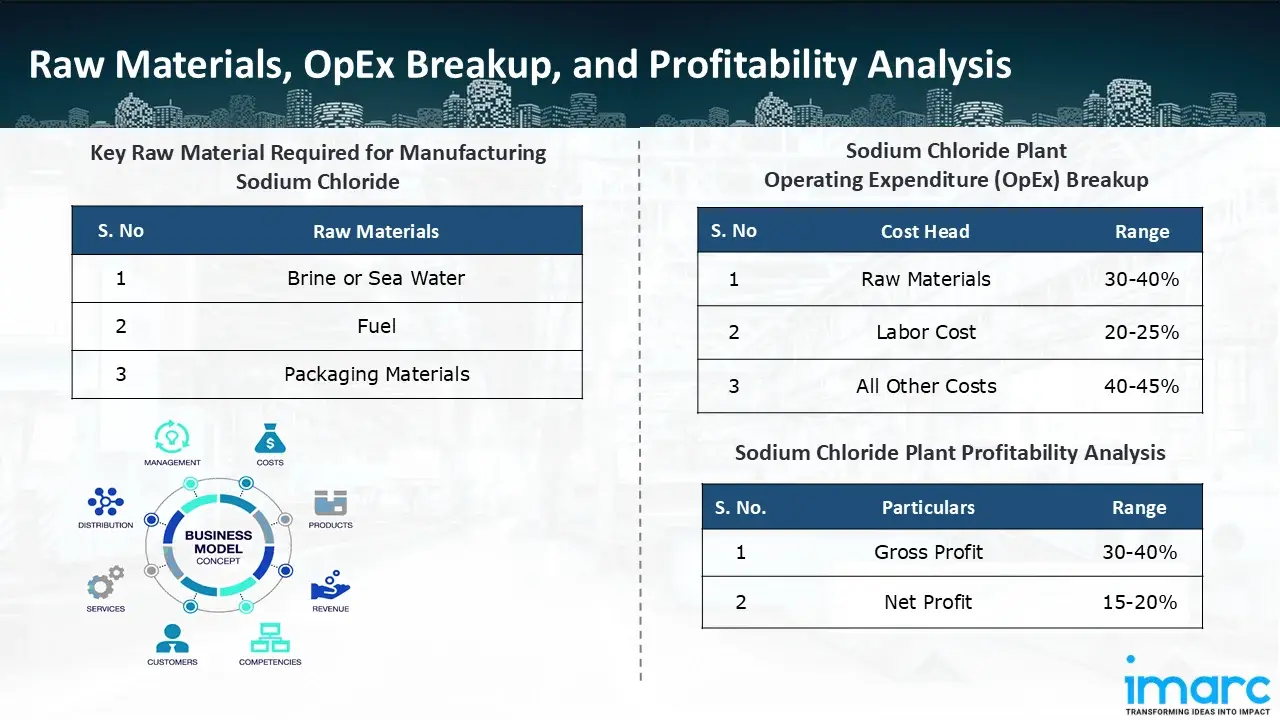
Get a Tailored Feasibility Report for Your Project Request Sample
Raw Material Required:
The basic raw materials required for sodium chloride manufacturing include:- Brine or Sea Water
- Fuel
- Packaging Materials
Machine Section or Lines Required:
- Evaporation
- Crystallization
- Centrifugation
- Drying
- Iodization
- Packing
Techno-Commercial Parameter:
- Capital Expenditure (CapEx): Capital expenditure (CapEx) in a manufacturing plant includes various investments essential for its setup and long-term operations. It covers machinery and equipment costs, including procurement, installation, and commissioning. Civil works expenses involve land development, factory construction, and infrastructure setup. Utilities such as power, water supply, and HVAC systems are also significant. Additionally, material handling systems, automation, environmental compliance, and safety measures are key components. Other expenditures include IT infrastructure, security systems, and office essentials, ensuring operational efficiency and business growth.
- Operating Expenditure (OpEx): Operating expenditure is the cost incurred to operate a manufacturing plant effectively. OpEx in a manufacturing plant typically includes the cost of raw materials, utilities, depreciation, taxes, packing cost, transportation cost, and repairs and maintenance. The operating expenses are part of the cost structure of a manufacturing plant and have a significant effect on profitability and efficiency. Effective control of these costs is necessary for maintaining competitiveness and growth. Furthermore, raw material cost in sodium chloride manufacturing plant ranges between 30-40%, labor cost ranges between 20% to 25%, and all other costs ranges between 40-45% in the proposed plant.
- Profitability Analysis Year on Year Basis: We assisted our client in developing a detailed cost model, which projects steady growth, with revenue rising throughout the projected period. Moreover, gross profit margins lie between a range of 30-40%, and net profit lie between the range of 15-20% during the income projection years, highlighting strong financial viability and profitability.
Conclusion & IMARC's Impact:
Our financial model for the sodium chloride manufacturing plant was meticulously developed to meet the client’s objectives, providing an in-depth analysis of production costs, including raw materials, manufacturing, capital expenditure, and operational expenses. By addressing the specific requirements of manufacturing 15,000 tons of sodium chloride annually, we successfully identified key cost drivers and projected profitability, considering market trends, inflation, and potential fluctuations in raw material prices. This comprehensive financial model equipped the client with valuable insights into strategic decision-making, demonstrating our commitment to delivering high-quality, client-focused solutions that ensure the long-term success of large-scale manufacturing ventures.Latest News and Developments:
- In June 2025, Morton Salt announced that its Consumer business will greatly expand its production capacities to improve customer dependability throughout North America. The company's annual evaporated salt and solar salt production networks in North America will grow by around 500,000 tonnes and 360,000 tonnes, respectively, thanks to a number of recently finished and upcoming growth projects. The full expansion will be finished within the next 12 to 18 months, with some of the increased capacity already finished and operational.
- In December 2024, Goyal Salt Limited, a prominent FMCG firm that specialises in salt, announced the release of "Goyal Black Salt," a new product that significantly expands the company's product line.
Why Choose IMARC?
IMARC's Financial Model Expertise: Helping Our Clients Explore Industry Economics
IMARC is a global market research company that offers a wide range of services, including market entry and expansion, market entry and opportunity assessment, competitive intelligence and benchmarking, procurement research, pricing and cost research, regulatory approvals and licensing, factory setup, factory auditing, company incorporation, incubation services, recruitment services, and marketing and sales. Under our factory setup services, we assist our clients in exploring the feasibility of their plants by providing comprehensive financial modeling. Additionally, we offer end-to-end consultation for setting up a plant in India or abroad. Our financial modeling includes an analysis of capital expenditure (CapEx) required to establish the manufacturing facility, covering costs such as land acquisition, building infrastructure, purchasing high-tech production equipment, and installation. Furthermore, the layout and design of the factory significantly influence operational efficiency, energy consumption, and labor productivity, all of which impact long-term operational expenditure (OpEx). So, every parameter is covered in the analysis. At IMARC, we leverage our comprehensive market research expertise to support companies in every aspect of their business journey, from market entry and expansion to operational efficiency and innovation. By integrating our factory setup services with our deep knowledge of industry dynamics, we empower our clients to not only establish manufacturing facilities but also strategically position themselves in highly competitive markets. Our financial modeling and end-to-end consultation services ensure that clients can explore the feasibility of their plant setups while also gaining insights into competitors' strategies, technological advancements, and regulatory landscapes. This holistic approach enables our clients to make informed decisions, optimize their operations, and align with sustainable practices, ultimately driving long-term success and growth.Our Clients







Contact Us
Have a question or need assistance?
Please complete the form w𒁏ith you♊r inquiry or reach out to us at
+1-201-971-6302
+44-753-714-6104
Previous Post
