Elemental Economics: Strategic Cost Modelling for Lanthanum Oxide Manufacturing
_11zon.webp)
What is Lanthanum Oxide?
Lanthanum oxide (La2O3) is a white, odorless, and extremely stable rare earth compound obtained mainly from monazite and bastnäsite ores. It is essential for a vast array of industrial uses such as the manufacture of optical lenses, ceramics, phosphors, and battery electrodes.
Key Applications Across Industries:
Lanthanum oxide is also used extensively as a catalyst in petroleum refining processes, particularly in fluid catalytic cracking (FCC) operations. Due to its exceptional electrical, optical, and catalytic properties, La2O3 is an important material for advanced technologies like electric vehicles (EVs), smart electronics, and renewable energy devices.What the Expert Says: Market Overview & Growth Drivers
The global lanthanum oxide market was reached 32 Thousand Tons in 2025. According to IMARC Group, the market is projected to reach 41 Thousand Tons by 2034, growing at a CAGR of 2.69% 🤪from 2026 to 2034. The worldwide demand for lanthanum oxide is mostly stimulated by the growth of high-tech and green in✤dustry. One of the main factors for growth is its application in nickel-metal hydride (NiMH) batteries, which are used extensively in hybrid cars and consumer electronics.
Growing production of electric and hybrid cars, mainly in China, the U.S., and Europe is stimulating this demand. Additionally, the critical function of lanthanum oxide in making optical glass for camera lenses and precision equipment underlies its increasing use in the imaging and electronics industries. A further important driving factor is its application as a catalyst in fluid catalytic cracking (FCC) in the oil refining business, where there is a continuous demand for efficiency and emission minimization. The global move towards clean energy and decarbonization is also driving research and utilization of rare earth oxides such as La2O3 in high-tech ceramics, fuel cells, and hydrogen storage devices. Moreover, geopolitics and supply chain concentration in China are also impacting the market dynamics and long-term investment plans in lanthanum oxide manufacturing worldwide.
Case Study on Cost Model of Lanthanum Oxide Manufacturing Plant:
Objective
One of our clients reached out to us to conduct a feasibility study for setting up a large-scale lanthanum oxide manufacturing plant.
IMARC Approach: Comprehensive Financial Feasibility
We developed a comprehensive financial model for the setup and operation of a proposed lanthanum oxide manufacturing plant in Turkey. This plant is designed to produce 300,000 tons of lanthanum oxides per day.Manufacturing Process: The process of lanthanum oxide production requires careful steps to produce high-purity nanoparticles. The procedure starts with the choice and purification of analytical-grade lanthanum nitrate and acetamide, which are dissolved in distilled water to ensure minimal impurities. These reagents are mixed well and agitated to produce a homogeneous mixture, which is critical in ensuring uniform combustion and equal particle formation. The blend is thereafter burned, and a combustion reaction occurs where lanthanum nitrate serves as the oxidizer and acetamide as the combustible. Combustion generates heat and gas that propels the reaction to produce initial lanthanum oxide particles. After combustion, the sample is subjected to a muffle furnace of approximately 600°C to facilitate crystallization and sintering. The mixture is then annealed for 4–5ꦉ hours to improve particle structure, lower defects, and enhance crystallinity. Sintering upon annealing enables particles to weld together, forming well-defined La2O3 nanoparticles. Upon cooling, the nanoparticles are harvested and characterized by methods such as X-ray diffraction or electron microscopy. According to the characterization, further processing could be performed to customize the nanoparticles for applications like catalysis or electronics to deliver maximal performance and product quality.
_11zon.webp)
Get a Tailored Feasibility Report for Your Project Request Sample
Mass Balance and Raw Material Required: The primaryꦍ raw materials use☂d in the lanthanum oxide manufacturing plant include lanthanum nitrate and acetamide. For a plant producing 1 ton of lanthanum oxide, 0.88 ton of lanthanum nitrate and 0.23 ton of acetamide.
List of Machinery:
The following equipment was required for the proposed plant:- Raw material storage system
- Hopper
- Electronic Vibrating Feeder
- Bucket elevator
- Raw Material Silo
- Screw Valve
- Raw material crushing and grinding system
- Vibrating feeder
- Cone Crusher
- Belt Conveyor
- Material Distribution Chute
- Ball Mill
- Classifier
- Magnetic Selector
- Close type belt conveyor
- Buffer Mixing tank mixing system
- Hydrometallurgical system
- Calcination system
- Product Packing system
Techno-Commercial Parameter:
- Capital Investment (CapEx): Capital expenditure (CapEx) in a manufacturing plant includes various investments essential for its setup and long-term operations. It covers machinery and equipment costs, including procurement, installation, and commissioning. Civil works expenses involve land development, factory construction, and infrastructure setup. Utilities such as power, water supply, and HVAC systems are also significant. Additionally, material handling systems, automation, environmental compliance, and safety measures are key components. Other expenditures include IT infrastructure, security systems, and office essentials, ensuring operational efficiency and business growth.
- Operating Expenditure (OpEx): Operating expenditure is the cost incurred to operate a manufacturing plant effectively. Opex in a manufacturing plant typically includes the cost of raw materials, utilities, depreciation, taxes, packing cost, transportation cost, and repairs and maintenance. The operating expenses are part of the cost structure of a manufacturing plant and have a significant effect on profitability and efficiency. Effective control of these costs is necessary for maintaining competitiveness and growth.

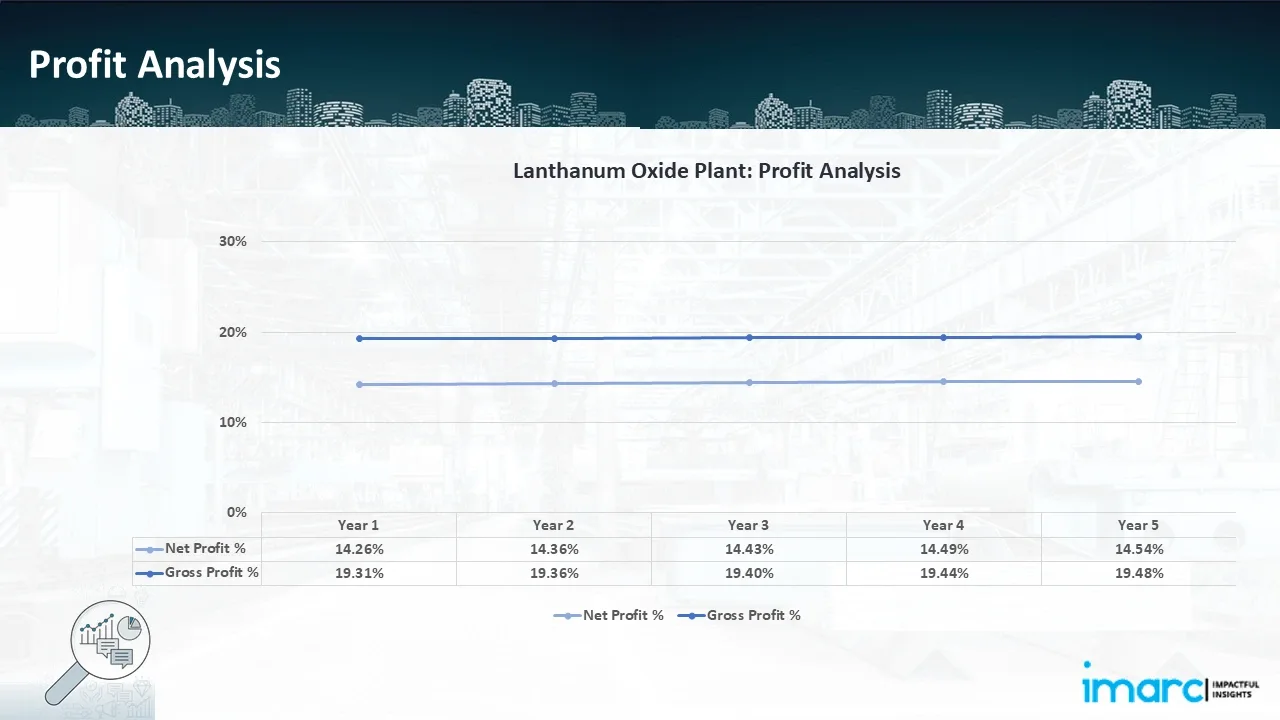
- Profitability Analysis Year on Year Basis: The proposed lanthanum oxide plant, with an annual capacity of approximately 300,000 tons of lanthanum oxides, achieved an impressive revenue of USD 285.6 Million in its first year. We assisted our client in developing a detailed cost model, which projects steady growth, with revenue rising throughout the projected period. Moreover, gross profit margins improve from 19.31% to 19.48% by year 5, and net profit rises from 14.26% to 14.54%, highlighting strong financial viability and profitability.
Conclusion & IMARC's Impact:
Our financial model for the lanthanum oxide manufacturing plant was meticulously developed to meet the client’s objectives, providing an in-depth analysis of production costs, including raw materials, manufacturing, capital expenditure, and operational expenses. By addressing the specific requirements of producing 300,000 tons of lanthanum oxide annually, we successfully identified key cost drivers and projected profitability, considering market trends, inflation, and potential fluctuations in raw material prices. This comprehensive financial model equipped the client with valuable insights for strategic decision-making, demonstrating our commitment to delivering high-quality, client-focused solutions that ensure the long-term success of large-scale manufacturing ventures.Latest News and Developments:
- In June 2025, India has requested that state-run miner IREL halt a 13-year-old contract on rare earth exports to Japan and protect supply for domestic consumption to lessen its reliance on China.
- In May 2025, Less Common Metals Ltd. (LCM), a manufacturer of rare earth metal and magnet alloys as well as other speciality materials, is situated in Cheshire, Northwest England. The company has revealed plans to build a €110 Million (USD 123 Million) plant in France. The supply chain for rare earths is intended to be strengthened by this advancement. LCM's rare earth metal and magnet alloy plant is planned to be built in Lacq, Southern France.
- In May 2025, Ucore Rare Metals Inc. ("Ucore" or the "Company") declared that it has established a formal fixed price agreement with the US Army Contracting Command-Orlando for an increase of USD 18.4 Million to its existing USD 4 Million Other Transaction Agreement.
- In January 2025, LKAB has now started building its new demonstration plant for processing rare earth elements and phosphorus in Luleå. The facility, the first in a planned industrial park, is a significant step towards the company's goal of using better resource utilisation to diversify its business with additional minerals.
Why Choose IMARC:
IMARC's Financial Model Expertise: Helping Our Clients Explore Industry Economics
IMARC is a global market research company that offers a wide range of services, including market entry and expansion, market entry and opportunity assessment, competitive intelligence and benchmarking, procurement research, pricing and cost research, regulatory approvals and licensing, factory setup, factory auditing, company incorporation, incubation services, recruitment services, marketing and sales. Under our factory setup services, we assist our clients in exploring the feasibility of their plants by providing comprehensive financial modeling. Additionally, we offer end-to-end consultation for setting up a plant in India or abroad. Our financial modeling includes an analysis of capital expenditure (CapEx) required to establish the manufacturing facility, covering costs such as land acquisition, building infrastructure, purchasing high-tech production equipment, and installation. Furthermore, the layout and design of the factory significantly influence operational efficiency, energy consumption, and labor productivity, all of which impact long-term operational expenditure (OpEx). So, every parameter is covered in the analysis. At IMARC, we leverage our comprehensive market research expertise to support companies in every aspect of their business journey, from market entry and expansion to operational efficiency and innovation. By integrating our factory setup services with our deep knowledge of industry dynamics, we empower our clients to not only establish manufacturing facilities but also strategically position themselves in highly competitive markets. Our financial modeling and end-to-end consultation services ensure that clients can explore the feasibility of their plant setups while also gaining insights into competitors' strategies, technological advancements, and regulatory landscapes. This holistic approach enables our clients to make informed decisions, optimize their operations, and align with sustainable practices, ultimately driving long-term success and growth.Our Clients








Contact Us
Have a question or need assistance?
Please complet♔e the form with your inquiry or reach𓂃 out to us at
+1-201-971-6302
+44-753-714-6104
Previous Post
